Getting Healthy and Fit in Basel

Basel weight loss
Still carrying extra weight from your holiday? Read on!!

Let me guess. You’re still carrying a little extra weight from your holidays and you want to trim down a bit?  Or maybe you’ve been gunning for that promotion, putting in the extra hours at work, sacrificing some of your recreational activities and exercise, and grabbing some fast food at lunch or on the way home from work?

Maybe you’ve noticed in the last few years, you’ve been putting on a little bit of padding in the mid-section and it doesn’t seem to come off as easily as it used to, or you get tired more easily than you did in your 20’s.

The bad news is, as you get older, you have to do more work to stay in shape and watch what you eat and drink a little more carefully. You also may have to reconsider or even stop some of the things you used to do, like drinking too much, smoking or playing heavy contact sports. The good news is that Basel is an awesome place to get fit and stay healthy.

This post will give you information on ways you can stay healthy, fit and trim in Basel, but remember, it will take hard work, self-control and it won’t happen overnight! You should definitely talk to your physician about before trying to lose weight, starting an exercise program or quitting smoking. They can also provide advice on quitting smoking or other aspects of improving your health.

Eating Right in Basel

Eating right in Basel
Eating healthy in Basel is easy.

Eating right is the single most important thing you can do to stay healthy and fit in Basel. Healthy eating should not be about staying depriving yourself of the foods you enjoy, but about making small changes to your eating behaviors to improve your health. Eating more fresh vegetables, cooking your meals at home, and reducing your intake of sugar and refined carbohydrates are important aspects of eating healthy in Basel.

  • Cook your own meals as often as possible – Cooking at home allows you to control what you put into your meals. Having difficulty finding time to shop? Try the Migros LeShop program. They usually have a free voucher for your first purchase as an incentive to check things out, and they deliver right to your door. You can request delivery during the day, in the evening (from 4.30 pm – 8 pm) or on Saturday morning (from 9am – noon).  Still too much effort? Go to HelloFresh, where they show up at your door with all the ingredients pre-selected and a recipe for you to follow. Maybe you don’t know any healthy recipies? You can order easy, paperless cookbooks that focus on preparing quick, healthy and delicious meals regardless of whether you want to lose weight or increase your muscle mass
  • Make healthy substitutions – Replace unhealthy foods in your diet with healthy alternatives. Have grilled chicken, instead of fried. Order a side salad or seasonal vegatables with your meal instead of french fries. Have whole wheat bread or pasta instead of their refined flour equivalents. Try spreading mashed avocado on your sandwich instead of butter or mayonnaise.
  • Get fresh – Wherever possible opt for fresh, varied foods over their packaged and processed counterparts.
  • Learn to read the labels – You’d be surprise about how much sugar, fat and other junk is in packaged food claiming to be healthy.
  • Make sure you get enough protein – Not only is protein important to build muscle and maintain your body, but its also very satisfying to your appetite. If you increase the amount of protein you eat, you’re less likely to reach for the potato chips or scarf down that pastry. One great way to increase your protein intake is by drinking protein shakes. You can get protein powder for shakes in assorted flavours from most sports stores, gyms or just order it online.
  • Drink water in Basel
    Drink water and lay off sugary sodas and alcohol to get fit in Basel.

    Drink plenty of water – Water helps your body to function efficiently and just drinking it uses up energy burning calories (it heats the water to body temperature before you excrete it). Don’t spend your life dehydrated. Drink water. Lots of it. This will also reduce your hunger, making it easier for you to make healthy food choices.

  • Supplements – If you plan your meals well, your diet should contain sufficient vitamins and minerals to support your health. If you’re not eating well, or have a substantially reduced the amount of food you’re eating in order to lose weight, you might need to supplement your diet with vitamins. You can buy these at most grocery stores or pharmacies, but there are lots of online shops where you can also get supplements you might want.
  • Eating out – You need to be careful when you go out to eat, as its really easy to go overboard on both the food and the drinks.  Opt for grilled fish or chicken, with a starter or side salad. You can have dessert, but consider healthy options like a fruit salad. As you can’t control the ingredients or portion size at a restaurant, try to only eat out on special occasions.

Exercising in Basel

If you’re comfortable with your weight, but you want to tone up or build some muscle, then you need to start exercising. Depending on what you like doing, you’ve got a world of options in Basel…are you an outdoor person who loves getting back to nature? Do you prefer competitive athletics like playing sports against other people as a team or one on one? Maybe you want to have your workouts in the same environment regardless of the season or the weather outside, or need special equipment to help your training program. Or maybe you want to train at home? 

  • Hiking boots in Basel
    Go hiking and get moving outdoors to get fit in Basel.

    Outdoor Workouts – Want to get out of the house and do something outside? Hiking is a great workout and there are loads of trails in the region. Want something a little more vigorous? Think about a Vitaparcours, where you run or walk along a fitness trail equipped with obstacles or exercise stations distributed along its length like stepping posts, chin-up bars and climbing bars. Try the local Vitaparcours Basel near the Tierpark Lange Erlen. Like to swim? Think about going swimming in the Rhine during the summer for a great outdoor workout. Keeping it simple and spartan? Buy a good set of trainers and start running. You can do it anywhere, it gets you to places and its good for you too!

  • Competitive Sports – Whether you want to play on a team or you’re interested in more one on one athletics, you can probably find it in Basel. In fact, the city has a database where you can find information about whatever sport you might want to play.
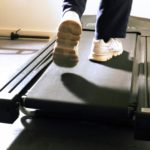
  • Basel man on a treadmill
    There are lots of local gyms in Basel, think about joining one to get fit!

    Joining a Gym – There are multiple gyms across Basel, but before you sign up, be sure you check that your employer doesn’t already have an onsite gym. Company gyms are generally cheaper than private facilities, and often more convenient. For a one year membership, you can expect to pay somewhere between 600 CHF – 1800 CHF.  Most gyms will offer a contract for a year, often payable by the month. If you’re around for less than a year, be sure to ask if they have shorter term memberships. There are many small neighborhood gyms located all over the city, so if proximity is important to you, use a gymfinder. You should talk to the staff when you join so they can show you how to use the equipment and split your time between resistance training (weights) and cardiovascular fitness.

  • Training at home – If you don’t have a dedicated space for weights and other training equipment in your home that doesn’t mean you can’t still train at home. There are great materials to guide you in doing workouts using your own bodyweight for resistance. This is also a very inexpensive option to get fit.

Things to Stop Doing

Burning cigarette in Basel to quit smoking
To get healthy and fit in Basel you need to give up some of your bad habits!

Smoking – It doesn’t matter how old you are or how much you smoke, this is something you need to stop as soon as possible. Smoking will wreck your heart and lungs, in addition to making you smell awful. Stopping smoking is really difficult, but you don’t need to do it alone. There are helpful guides to help you quit and support programs available locally.

Drinking too much or too often – Heavy or binge drinking wrecks havoc on your body, (including reducing your ability to metabolize fat if you’re trying to lose weight). It also lowers your sleep quality, impairs your jugdement and causes long term damage to multiple organ systems.

Shopping in Basel, Switzerland

Grocery Shopping in Basel

The cost of living in Basel Switzerland overall is relatively high, compared to other countries, so take a deep breath when you go into a grocery store, and be sure to look at the prices before buying something, especially if there is a service component involved (i.e. the butcher or cheese counters). Meat is especially expensive, but often goes on sale. I remember one time I went to the meat counter, before a barbecue to buy two smallish shish kebabs (meat and vegetables on a wooden skewer) from the deli counter and it came to 34 CHF. Ouch! Luckily, Basel is not the most expensive of the Swiss Cantons, so it could be worse.  Be sure to take advantage of sales, often indicated by the word ‘ACTION or AKTION’. Other than the standard sales, you can often find even better prices on weekends. Check the websites and the flyers to find the best deals.

grocery shopping in Basel
The coop has lots of fresh groceries for you to shop for in Basel

There are two major chain grocery stores in Basel, Switzerland: Co-op and Migros. You might find that the supermarkets in Basel are smaller than the supermarkets you’re used to, especially if you’re from North America. They don’t keep as many brands or flavors, but everything is there for the most part. There still might be some things from home that are not sold here, but you’ll be able to find almost everything you need.

If you find you have a preference for one chain or the other, you might want to get a loyalty card at one or both of them (Supercard at the Coop, Cumulus card at the Migros). Denner is a chain of discount grocery shops. It’s a good place to get the basics, and generally has a broad selection of reasonably priced wines, beers and spirits. It’s a great place to go shopping before you have a party!! There are other supermarket chains in the city (Aldi, Lidl), but you’ll come across these less frequently than those listed.

Opening Hours

The chain grocery stores are generally open from 8am-6pm on weekdays (but some of these stores close over the lunch hour). There are some that stores that are open earlier as well as later (till 7 or 8pm). On Saturdays, these chain supermarkets normally have later opening hours and earlier closing hours.  On Sundays, these shops are usually closed. If you go to the SBB train station, or to Barfusserplatz, you’ll find stores open as late as 10pm, seven days a week.

Grocery Delivery

If you don’t have time to go shopping or simply don’t want to, the LeShop program by Migros will allow you to order groceries online and have them delivered to your door, or have them ready for you to pick up. This is very convenient, and I suggest you try it at least once to see if you like the service.

Family Run Shops

There are also lots of smaller family run shops all over the city, which are often open till 10pm. These generally have the basics available, and are more for convenience than for a full shopping trip. I have not encountered any grocery shops open later than 10pm.

Shopping for everything else in Basel

Going shopping in Basel isn’t too different than anywhere else. If you want to shop at a mall, the major malls are located on the outskirts of the city, and are usually open till 8pm on weekdays. Stores close earlier on Saturdays, and are generally closed on Sundays. Around Christmas, many stores have extended hours and stay open on Sundays, but not all, so be sure you check before you decide to do your holiday shopping!

There are also smaller shopping complexes located across the city, as well as individual shops. Most of the larger chain stores accept credit and debit cards, and cash. Personal checks are generally not accepted.

Large shopping centers

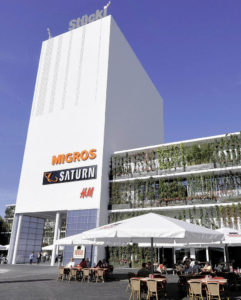
St. Jakob-Park and Stücki are the main large shopping centers in Basel.

photo of St Jakob mall in Basel, Switzerland
St Jakob-Park Shopping Center has lots of different shop!

St. Jakob-Park – is a three-level mall with over 50 shops and restaurants. It’s located across from the St. Jakob Gartenbad, and is accessible by the number 14 tram as well as bus number 36 or 40.


StückiStücki – Is a two-level mall with over 100 shops and restaurants. There is a food court, as well as a children’s play area.  You can reach Stücki by tram 8 or 17, as well as with bus 36; get off at Kleinhüningen.
Other shopping areas

You definitely don’t need to go to the two malls to find everything you need. There are less concentrated shopping areas across the city. One of the major shopping areas is located on Freiestrasse, in the heart of the old town of Basel. In addition to the numerous shops and cafes, there are often street performers and decorations depending on the season.

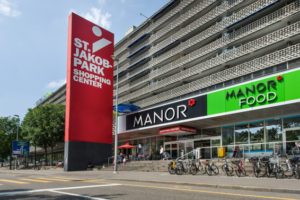
There is also another large aggregation of stores near the Claraplatz area. The department store Manor is a Basel staple where you can find almost anything, in addition to having a full size grocery store.

There are also shops, restaurants and bars located on Steinenvorstadt, as well as movie theaters, cosmeticians, and other businesses.

Late night shopping

Shopping outside of regular business hours is difficult to find.  Many shops at the Basel SBB train station are open till 9pm. There are also late night grocery stores around the station.

Cross – border shopping

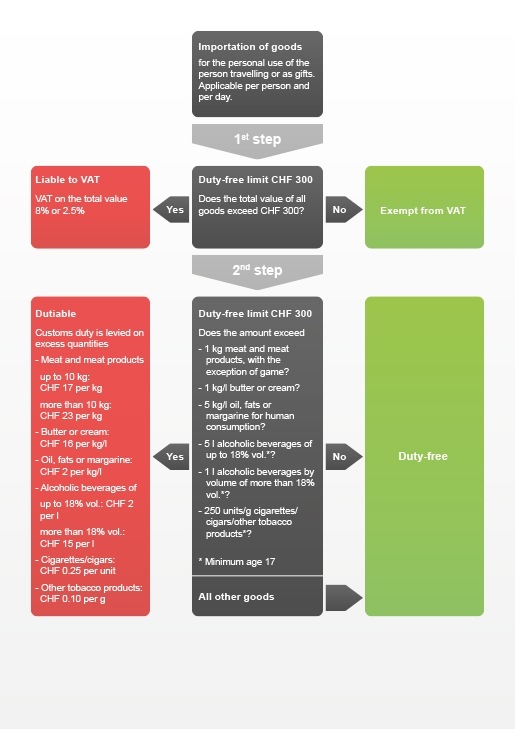
If you want to take advantage of your proximity to Germany and France, you can do some shopping across the border. The easiest access to cross-border shopping, in my opinion is the Rhein Center in Germany. Located just across the border in Weil am Rhein, the Rhein Center has a wide variety of shops including a massive grocery/department store (Marktkauf), and numerous, smaller specialty shops. There are also movie theaters and a gym. If you shop across the border, make sure you are aware of what and how much you can bring back. The number 8 tram goes directly to the Rhien Center making it very easy to get to.

Flow chart summarizing the regulations for crossing the border with your shopping purchases
Rules for importing goods in to Basel, Switzerland after you go shopping in Germany or France

Remember to always take your passport when crossing the border; your residence permit is not enough. In addition to the cheaper cost of goods in France and Germany, you might be eligible for a refund on foreign VAT. Generally, you can get a form at the customer service department of the shops across the border, where you’ll have to fill in some information and attach the receipt. You take this to the French or German border, with proof you’re not from the country, and they will stamp your VAT form. Then, when you are next at the same shop, you bring the stamped form to the customer service desk, sign and date it, and hand it to them. They’ll give you cash back for the VAT. These stamped forms usually expire between 3-6 months, so don’t wait too long to claim back your VAT.

Liability, Household, Life, and Car/motorcycle Insurance in Basel

In addition to the compulsory health insurance you’ll need when you move to Basel, you’ll need some other kinds of insurance to protect yourself, and your loved ones. In this post, I’ll outline a few of the different types of insurance and provide you with some information so you can begin to make an informed decision. Be sure to do your due diligence, as much of what is discussed below can change depending on the company, and the policy.  There are many other types of insurance not discussed here, but I tried to cover the main ones. Please note, I’m not an insurance expert, so please talk to an insurance agent, before buying your insurance!

Georges Kreiss +41-76-323-7753 Georges.Kriess@goldblumcie.ch
Georges Kreiss
                     +41-76-323-7753
      Georges.Kreiss@goldblumcie.ch

If your German is not yet up to par, it’s important to find an insurance broker who speaks English well, so they can explain what coverage you have and how to make a claim if you need to. My insurance agent is Georges Kreiss; he’s an insurance broker for a company called Goldblum and Cie. As a broker, he represents multiple insurance companies, so he can tell you who provides the best coverage for your particular insurance needs. He’s always happy to discuss my insurance needs in person or, on the phone or by email. I particularly like Georges, as he’s flexible. He’ll adjust his schedule to suit mine if I have questions and works hard to move things forward quickly. He’ll also proactively drop me a mail or call me occasionally to make sure that I’m happy with my current coverage and to see if I have any other questions or need adjustments to my policies.

Personal liability insurance

basel insurance liability
Personal liability insurance covers damage done to others

Personal liability insurance coverage protects you financially against damage caused by you or a member of your family living in the same dwelling to a third party. For example:

  • You’re on holiday, and the pipes in your flat burst;  the water damages leaks down to your downstairs neighbors and floods his place, wrecking lots of his stuff
  • You’re riding your bicycle and someone jumps directly in your path and you hit them, causing injury (and hospital bills)
  • Your children are playing ball an accidentally break someone’s window

Damaging third-party property or injuring another person means you’ll be held responsible to pay compensation to that person. These types of claims can be incredibly expensive, and this type of insurance protects the policy holder against such financial risks.

Personal liability insurance is also really important if you’re trying to rent an apartment. Most landlords/rental companies will refuse to rent to you unless you can provide proof of coverage.

Content insurance

basel content insurance
Content insurance protects your personal belongings

Content insurance covers your household contents against damages caused by fire, water & (usually) theft in your home.  This includes furniture and personal items that are stolen or accidentally damaged. If you accidentally break something in the apartment, this can usually be claimed through your household insurance. Stolen bicycles are also covered by this insurance, for the most part. If you have an expensive bike you might need additional protection (a supplement), as the costs are generally only covered up to a specified amount.

Household insurance

Personal liability and content insurance will most often be sold as a package by your insurance company, under the blanket term ‘household insurance’. Buying the two together as a package is often slightly less expensive, than getting each individually.

Be sure that you know exactly what you are being covered for when you buy your insurance. I would very strongly recommend that everyone has a household insurance package or individual content and personal liability insurance at minimum. The costs per year are very reasonable, and if you don’t have it, you’ll kick yourself when something happens.

Insurance supplements

Insurance supplements are specific, additional insurance modules that provide extra coverage depending on your individual needs. Supplementary modules can be the inclusion of high-cost valuables (jewellery, antiques, etc.), simple theft outside the home or insurance for damage due to unusual forces of nature. Depending on what you own and your lifestyle, so should discuss appropriate supplements with your insurance agent to add to your basic household coverage.

Life Insurance

life insurance in Basel
Life insurance is important if you have dependents.

If you are employed by a company, you likely have some level of coverage by the state pension (AHV) and occupational pension (BVG) contributions that you pay each month (look at your pay slip and you’ll see these are deducted from your salary every month. Your employer should be able to provide you with details of the level of coverage and what benefits your dependants would receive upon your death.

If you feel you need additional coverage, you can take out a private life insurance policy. There is too broad a range of life insurance products and packages available, to go into this post. To find out what life insurance best suits your needs, talk to your insurance agent. The number, sex and age of your dependents, your financial status, lifestyle (e.g. smoking) and health status will all be factors in deciding what health insurance you need, and the premiums you’ll pay.

Car and motorcycle insurance

If you own and operate a motor vehicle in Switzerland, you’re going to need insurance for it. Premiums depend a lot on what vehicle you own, as well as your age, experience and driving history. Less expensive vehicles, with less powerful engines will be charged lower premiums than fast, expensive ones. There are also premium saving models that you might be able to take advantage of, if they are compatible with your vehicle and your lifestyle. For example, some insurance policies have reduced premiums for environmentally friendly vehicles, like hybrids. Others, will reduce premiums based on compliance with specific conditions, like exclusive use of a partner garage for regular maintenance and repairs. Talk to your insurance agent to make yourself aware of these money saving options.


Motor vehicle liability insurance

motor vehicle liability insurance in Basel
Motor vehicle liability insurance is a must if you drive in Basel

Motor vehicle liability insurance is mandatory if you drive a car or motorcycle (or any other motor vehicle). It protects you, the driver, financially for the damage that you might cause to a third party (the other people involved in the accident such as drivers, cyclists or pedestrians) if you’re involved in a traffic accident. Liability insurance also offers protection against unjustified third-party claims. This insurance covers both personal injury and property damage, but only for third parties.


Voluntary motor vehicle insurance – accident insurance, partial accidental damage coverage, collision insurance

While the mandatory motor vehicle liability insurance that covers damages you cause to others, you can also get other types of insurance that are voluntary: accident insurance, partial accidental damage coverage and collision insurance.

Accident insurance

If individuals are injured or killed in a traffic accident, this insurance protects the driver and passengers of the vehicle against any financial consequences, regardless of who was at fault. It may cover additional medical expenses (in a private room if inpatient care is required), daily benefits, and/or a disability or death lump sum.

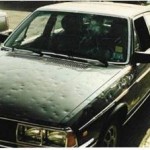
car insurance in BaselPartial accidental damage insurance covers a breadth of different factors depending on what policy you choose. Possible coverage includes, some weather damage (like hailstones, flood), colliding with a large animal and theft. Be sure to discuss what protection you need with your agent, to get the ideal policy for you.

Collision insurance provides coverage for damages your own vehicle suffers as a result of a collision, often regardless of whose fault it is. It covers the repair costs, or the replacement of the vehicle should it be totally destroyed in the accident.

You need to consider how old your vehicle is, and whether you feel accidental damage and collision insurance is worth it to you, and if so, to what level you need it. Again, a discussion with your insurance agent is the quickest way to determine what level of motor vehicle insurance you need.

Often partial accidental damage insurance and collision insurance are sold together as a package known as comprehensive insurance.


Motor legal

Motor legal protection can provide support to implement compensation claims against the person responsible for the accident, if you have is subsequent legal difficulty with your insurance company and can help to offset lawyer fees, costs of appraisals or court fees.

motor legal insurance in BaselThis type of insurance can also be useful, if you are involved in criminal proceedings because of a violation of traffic laws. Motor legal coverage can provide legal support when you become involve in legal proceedings with the traffic authorities. Yearly premiums for motor legal insurance are relatively low compared with fees for legal representation.

Motor legal protection insurance might also be worth considering for people who don’t drive. If you’re a pedestrian, struck by a vehicle motor legal protection insurance will support you to make a claim against the person responsible for the accident. Legal disputes often arise concerning the amount of a disability pension or the degree of work incapacitation. Motor legal protection might supplement contributions to the victims, as well as providing legal support.

If it’s possible, choose a motor legal protection insurance that allows you to choose your own lawyer. Lawyers employed by insurance companies might face internal pressure to make decisions that favor the company instead of you. Independent lawyers will not face this pressure concerning trial costs.

motorcycle insurance Basel
You might be able to get seasonal insurance for your motorcycle or scooter.

Sunshine insurance

If you only use your motor vehicle in the summer months (motorcycles, convertibles, etc.) the license plates can be left at the Strassenverkehrsamt to avoid paying premiums during the months you don’t drive that vehicle. Insurance premiums can be suspended during this period, saving you money. This option makes sense for drivers who only use their vehicle for a few months in the year, as you’ll pay some money for depositing and re-registering the vehicle every year. Some insurers also offer the option to waive suspension. In this case, you pay a relatively low premium for the entire year which takes into account vehicles not used during the winter. With this option, the vehicle does not need to be re-registered every year and you can still use it whenever you want if the weather co-operates.

Making an insurance claim:

You should report a damage case (property damage, an accident, etc.) to your insurance company immediately. Visual account of the damage – especially before and after photos and video – can be very helpful. For example, I take a video of our whole flat once a year (1-2 minutes of footage per room), so that if there is any damage, we have an up-to-date account of our possessions and the state they are recently in that I can share with the insurance company.

Never initiate repairs without reporting the problem and receiving the go ahead from your insurance. Sometimes insurance companies will need to bring in a damage assessment expert to help decide on the best course of action, before deciding on how to proceed with your claim. Sometimes, your coverage will stipulate that only specific, partner companies can take on repairs and you may not be reimbursed for using other providers.

Similarly, don’t start to replace damaged or stolen items until you’ve received the OK of your insurance company and are sure your claim is approved and your compensation has been received.

You should think carefully before making a claim on small costs.  Firstly, depending on your level of coverage, you’ll usually have to pay a deductible before your coverage kicks in.  Secondly, you might lose discounts and bonuses provided by your company based on a perfect (zero) claims record, which may cost you more in the long run. Finally, your insurance company is not obligated to continue insuring you.  If you abuse your insurance by claiming every little thing, your company might decide to terminate your policy. Once this happens, the insurance companies will share the information with other insurance providers, and you’ll have a terrible problem being covered by anyone.  This can make your life in Basel (or anywhere) very difficult.


To be covered by your insurance, you have to pay your insurance company, fully and on time. If you don’t pay your premiums on time, you risk reminder fees or termination of your policy.

Changing insurances

If you are already insured, unless you officially cancel your policy in writing, the contract is automatically renewed.In most cases, notification must be provided three months in advance. Terminations within a shorter period are sometimes possible such as in case of a premium increase by the company a change of vehicle, etc. Most insurance agents can provide you with a template for the termination letter or you can often find them on the insurance company website.

I hope this post has provided you with a basis to start looking at insurance for your life in Basel.  Be sure to do your due diligence and discuss your particular insurance needs with a qualified agent!

Owning a Dog in Basel – Guest Post

People with pets consider them a part of the family. Dogs are certainly my favorite in the pet category, and I’m looking forward to getting one soon. In the Moving to Basel e-book (only 11.99 USD), I’ve included 3 chapters on pets, including what you need to do for your pets to get them to Switzerland, how to actually arrange transportation for them, and some of the intricacies of owning a dog in Basel (or the rest of Switzerland). The e-book briefly describes the mandatory dog training needed in Switzerland, but when Gabriela Wehrli, a noted animal psychologist and dog trainer in Basel, offered to write a post for me detailing it I jumped at the opportunity!


Dog training in Basel
Gabriela Wehrli provides dog training courses in English
Gabriela Wehrli was born in Basel and lives in Pratteln with her husband, two daughters and two dogs. She studied English, history and German at the University of Basel and works for a local international organisation. She is a dog trainer and animal-shiatsu therapist.
If you struggle to understand your village’s dog regulations or the cantonal laws, please do not hesitate to contact her. She offers translation of such texts.
To contact Gabriela Wehrli for dog training or translation of pet related regulations, visit her website Kenkou – dog training and dog psychology in Basel.

Guest post for Life in Basel


Dog-laws in Switzerland

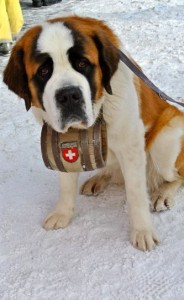
Owning a dog in Switzerland is great – you can take them for long romps on hundreds of beautiful hiking trails, bring them on public transport (there’s even special seat adapters for dogs on chair-lifts) and dogs are welcome in many restaurants and hotels. Even if you are living in the city, the nearest green oasis is usually not too far away. Many of my expat friends have told me that they are surprised at how well-trained and well-behaved most dogs in Switzerland are.

dog switzerland
Switzerland is a great place to have a dog!

However, after a tragic dog-attack in December 2005 involving a child, discussions around dog control and regulation started all over Switzerland. Under pressure from the public and the media, some cantons and villages created their own new regulations. Additionally, in September 2008, Switzerland enacted a new country-wide federal law for dog-owners. However, this legislation has been changed as of January 1st, 2017.

The dog-law-situation that is complicated for Swiss dog-owners, and almost impossible to understand for expats. The rules you must abide to differ not only from canton to canton, but literally from village to village.

This guest post gives an overview of the mandatory things you need to do when you get a dog. It also tells you what to look out for and where to get information as well as providing information about dog parks in the Basel region.


Federal mandatory courses for dog-owners

The federal law which forced dog-owners to attend a theoretical course before getting a dog (for first-time dog-owners only) and a practical course within a year of getting the dog has been discontinued as of January 1st, 2017. However, first time dog owners should inform themselves of the proper care and training for their dog, before getting one.

Registration and rules

Every dog must be registered with the village and dog tax needs to be paid. All dogs must carry a microchip (or tattoo) and must be registered with the AMICUS registry. The village and your vet will take care of this registration. Every dog-owner should have insurance coverage for dog incidents. Your insurance company can send you confirmation that you are covered. Coverage is usually included in your indemnity insurance (Haftpflichtversicherung). As a dog-owner you are held responsible if your dog harms humans or animals.

Every canton and village has an additional set of laws. There are, for example, many additional rules regarding breeds that are regarded as dangerous. Make sure you understand the laws in your canton, as well as neighbouring cantons, cantons you travel through or visit for holidays. Know the laws of your village and neighbouring villages.

There are separate rules for some breeds depeding on your canton. To see what breeds special rules apply  to in the canton where you live, please visit this webpage and then talk to your local vet or Gemeinde regarding the details. 

At the tierimrecht website you can find all the cantonal laws for both Basel-Stadt or Basel-Landt. For the village laws, it is best to ask for their specific dog regulations (Hundereglement) when registering your dog.

Forbidden training techniques and tools

Switzerland forbids hitting your dog, the use of prong collars, choke collars without a stop, or any device that uses electricity, chemicals or very unpleasant high-pitched noises to train dogs.

Vaccinations and de-worming

Dogs must be vaccinated and de-wormed regularly. If you travel abroad with your dog, it needs more vaccinations than for Switzerland only. Find a vet and talk to him/her about what you need. If your dog goes to a shelter while you are on holidays, ask the owners what vaccinations they require and then talk to your vet. Plan well in advance, to have enough time to get everything done.

Dogs have laws for the leash
Leash laws for dogs in Basel

Leash law, dog-free zones and more

In most areas it is mandatory to keep your dog on a leash in forests and close to forests from 1 April to 31 July. However, there are regions where you have to keep your dog on the leash in those areas all year long. And in the canton “Schwyz”, for example, dogs always have to be on the leash outside private properties. Check the cantonal law texts for the respective information. In the less strict areas, please only let your dog walk freely if it comes back promptly on command. Dogs that are seen hunting wild animals can be shot, and the owner will be fined.

In Basel, dogs must be walked on a short leash from 10pm to 6am, in restaurants, in public transport, near busy roads and on markets. Additionally, there are many areas that are marked specifically as dog-free zones (ie near kindergartens, schools, public swimming pools, some areas along the river Rhine, and more).

You might also not have known that in Basel, dogs are not allowed to take a bath in public fountains, or that you need a special approval if you want to keep two dogs that are more than 12 weeks old.

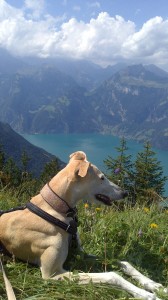
Dog in the mountains
Dogs are beautiful animals! They love Switzerland as much as the rest of us.


Dog parks

In Switzerland, the concept of dog parks is still very young. Basel has opened its first and so far only dog park in the Horburgpark in 2012. Given Switzerland’s space constraints and the fact that this dog park is in a city, please do not expect too much. There’s another nice dog park approximately a 30 minute car drive from Basel; Hundespielplatz Eiken. It is organised as a club, where you have to become a member and pay an annual fee in order to use the facility.

Coming back to my initial statement

Despite all these laws and regulations I still feel that owning a dog in Switzerland is wonderful. Keep in mind that all these laws were created after an accident, and not because the dog situation in Switzerland generally was getting out of hand. The average dog-owner will not have encounters with the police or law enforcement. Having to take the mandatory courses might seem a pain, but I am convinced that you will receive useful information and hopefully take something positive away from it.

I hope that Gabriela’s post has helped you clarify what needs to be done for dog owners in Basel, Switzerland! If you get a dog, make sure you know what you’re getting into, and take the steps above to ensure the animal is properly trained. Enjoy having a dog in Basel, Switzerland!

Swimming in the Rhine in Basel

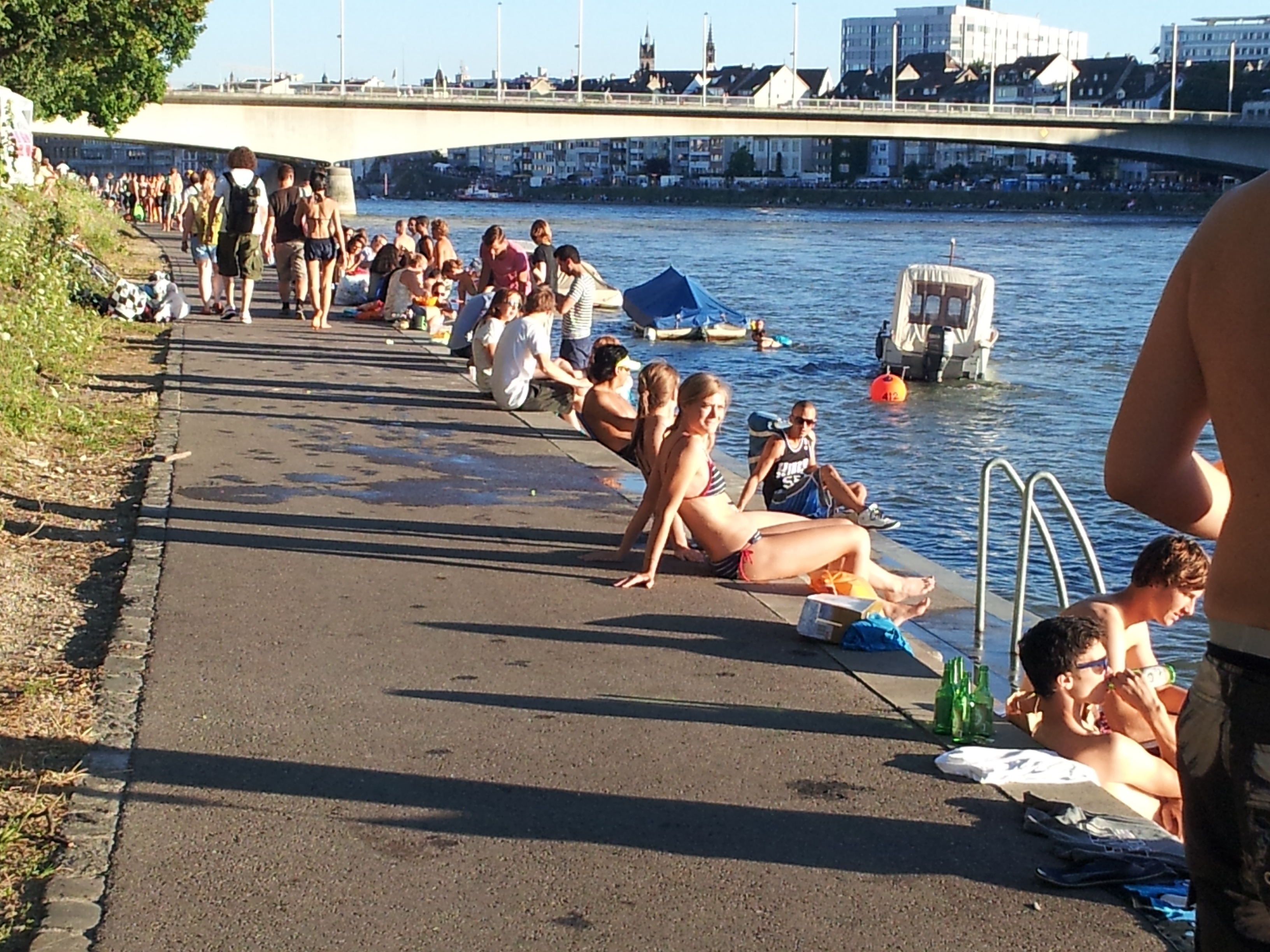
Summer at the Rhine
The Rhine in summer

Even if you’re new to Basel, I’m sure you noticed that the city is divided by a river. This river is the Rhein (English spelling: Rhine). In the summer months, you’ll also notice that lots of people like to swim in the Rhine (including myself). Others refuse to swim in the river, for various reasons. Even for people choosing not to take a dip, there are still lots of places to relax on the banks of the Rhine, and just enjoy the view.

I want to use this post to give you some information about the Rhine, make you aware of the dangers of Rhine swimming, and give you some tips, if you do decide to take the plunge. As with anything else in the world, know your limitations and be aware of what you’re getting yourself into before going for your first Rhine swim.

There is little I enjoy more than heading off on a sunny, summer day for a bbq by the Rhine. There are always lots of people of all nationalities, young and old, enjoying the summer by grilling, having a few cold drinks, and soaking up the sun. The atmosphere is generally very good, peaceful and relaxed. Most of the people coming to the river are tolerant if not friendly, and work on the ‘treat others as you’d have them treat you’ principle. Maintain a moderate level of respect for your neighbors. Don’t play your music too loud, don’t be obnoxiously drunk, clean up after yourself/children/pets and try not to drench any strangers if you jump in the water. The same way you’d hope them to be.

basel rhine summer

Swimming in the Rhine

I’m not going to lie to you, up until the 1990’s the Rhine river was a nightmare. It was used as the dumping ground for various industries, and was incredibly polluted with toxic, industrial chemicals. Since then, billions of Euros have been spent trying to clean up the Rhine. Fish populations are starting to recover, and the river is coming back to life. There are still higher levels of bacteria than you’d probably like (so don’t drink the water), and even though the river is much cleaner than it used to be, it’s still not as pristine as it could be. Also, a lot of people urinate in the river while swimming.  One more reason not to open your mouth in the Rhine!

Think before you decide to swim in the Rhine. If you are not a strong swimmer, don’t go! Its a river with a strong current, and there are no lifeguards to help you out of you start to struggle. The current changes drastically, depending on the water level and the time of year. Even if you are a good swimmer, be sure you go with some other people so if something unexpected happens (leg cramp, etc.) they can give you a hand. Don’t swim if you’re intoxicated, too tired, dehydrated, or have any other injuries or conditions that might affect your swim. It is not enough to be able to just float downstream, you really have to be a strong and confident swimmer.

Don’t jump or dive into the water. In addition to the irritating splash you’ll make, you may hit the bottom, depending on the level of the water, cutting your feet on rocks or glass. Certainly don’t dive in head first! Jumping off the bridges or hydroelectric damn will also get you hurt, killed or in trouble. I know one girl who was confined to a body cast for months, after foolishly jumping from one of the bridges.

The water can be cold. Really cold. Be sure to check the water temperature before start swimming. If you start feeling too cold, get to the side and get out of the water!! Stay close to the banks for the river when swimming and keep your eyes open for both big and small boats. When passing under the bridges keep away from the supports/pillars. There are strong eddies and currents that can be unpredictable. Don’t swim at dusk or after dark.

Know where you’re getting in and getting out of the river. Take a long walk or two along side the river, right to the end and know where you plan to get in and out. A great place to get into the water is just behind the Tinguely Museum. You can wade in, check the water temperature, assess the current and decide if you want to abort the swim.  If you miss the place you planned to exit, don’t panic; swim to the nearest bank. Don’t wait till the last exit point to leave the river. If you miss the last exit, you are screwed! There are lots of ladders and ramps to get out of the Rhine. Sometimes the ramps get very, slippery with algae, so be careful. I prefer the ladders.

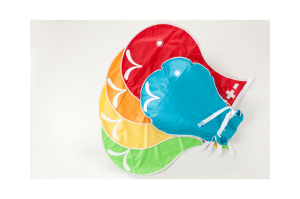
There are waterproof bags that you can buy in various shops online, in the city or along the Rhine. They are great for putting your clothes, wallet, watch, phone, etc. to keep them safe when you swim. They do leak from time to time so for your electronics and valuables, I’d suggest you bring along an extra ziplock bag to put these items in, in case you do spring a leak. Most of the waterproof bags are dual purpose; they double as a flotation device if you put some air in them before you close them. If you’re not a good swimmer, don’t rely on them too much. They’re no substitute for strong swimming skills. The most common water proof bag is the fish bag (Wickelfisch). These clever devices come in assorted sizes and colors, so hopefully you’ll find something to match your taste!

waterproof bag
Waterproof Fish Bags (Wickelfisch) come in lots of sizes and colors

The use of  inflatable swimming aids such as rubber tire tubes, air mattresses and inflatable rafts/boats is not allowed. There are police boats that drive up and down the Rhine and if they catch you in one of these, they may decide to fine you. If you follow the rules, take the proper precautions, use good judgement and think about what you’re doing, you’ll have a great Rhine swim.

Here is an interesting Youtube link, if you want to see what swim in the Rhine is like.

Rhine swim day

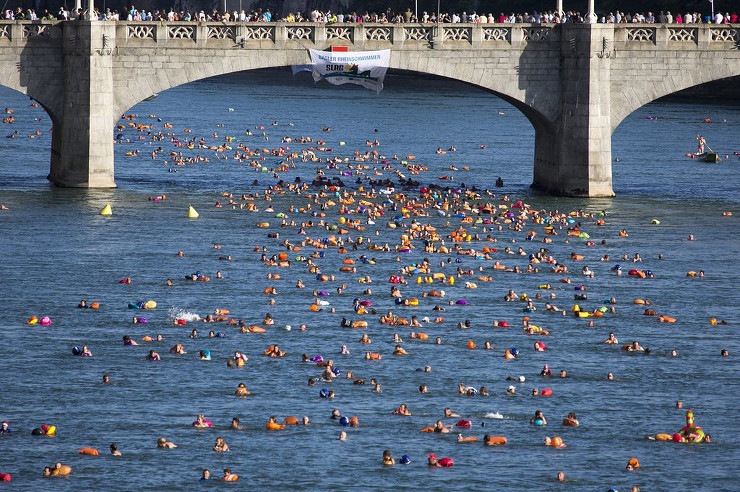
Every year there is a annual Rhine swim day, where thousands of people go to the river. You should decide whether it’s fun for you or if its the day you want to stay out of the Rhine.  In 2019, this is planned to take place on Tuesday, August 13th, 2019 around 18:00. If the weather is bad it will be re-scheduled (backup date of August 20, 2019).

Rhine basel swim
On the official Rhine Swim day, THOUSANDS of people take to the river.

Barbecuing / grilling by the Rhine is permitted, but please use common sense. You can buy small grills all over the place in Basel. Most chain grocery stores (Migros and Coop) carry disposable BBQs in the summer months, but they often don’t work very well. You can get small, reusable, portable charcoal grills that work much better for under 50 CHF. We got ours for 20 CHF at Interdiscount (an electronics shop) of all places, and its lasted a few years so far. Think about bringing a cooler to keep meat and drinks cold. Ice is hard to find in Basel and expensive when you do find it. If you have a decent amount of freezer space, fill a couple of ziplock sandwich bags with water and make your own ice a couple of days before. Or if you’re feeling posh, buy some reusable freezer packs with non-toxic blue gel.

I hope that this post has made you aware of both the pleasures and dangers of a day at the Rhine.  Be careful, have fun and enjoy your life in Basel!!

Paying your bills in Basel

Moving to Basel eBookIn addition to paying at Basel shops with credit cards, direct debit or cash, you’ll need to pay bills that come to you, either by mail or electronically, for rent, water, power, TV, phone, etc. Depending on what you’re used to in your home country, you might find paying your bills in Basel a bit different than what you’re used to. Personal checks are not used in Switzerland in general, but there are several other options to pay things.

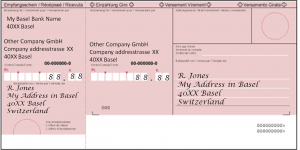
Payment slips (orange and red)

In Basel and the rest of Switzerland, slips of orange or red paper are come with most bills, often under the breakdown of the bill as a tear away sheet). On these slips there will be pre-printed information or blank spaces for or the payee (the company or person you owe money to), payor (you), the amount due and detailed bank account information. The German term for these slips is ‘Einzahlungschein’.

Most of the bills you receive from the larger companies (phone, tv, power, etc) will be of the orange type. Orange payment slips have a unique 27 digit reference number (called the ISR or ESR number) for that payment allowing companies to keep track of your payments easily. Red paying in slips do not generally have the reference number. These red slips are often provided by smaller businesses, individuals or for one off services. The ‘orange’ payment slip is a very light orange, and the ‘red’ paying in slips are closer to a light pink. If you bank online, be sure to look carefully to determine what color your bill is.

More and more companies are providing online bills, without payment slips, which just provide you with the information of the specific payment without a slip. If you’re just provided with bank account info (an account or IBAN number), you’ll probably select the tab to pay a red slip when paying online. If they give a unique 27 digit ISR reference number with the payment, then you’ll likely have the equivalent of the orange payments slip. My mobile phone company now does this, since I requested they go paperless. If you have any question on which type of payment to make, just call the person or company you plan to pay and they will be able to tell you.

The red payment slip:

  • This is a method to transfer money into the bank account of a person or company
  • The payment slip shows the IBAN of the person/company you’re paying as well as what bank they use
  • The amount due and the payer’s details may be pre-printed by the payee or you might have to fill in the amount and your name and address
  • You should put a short of the reason for payment in the specified field, so both you and the person you are paying know what this is for!
red einzahlungsschein
The red paying in slip generally comes from smaller companies or individuals.

The orange payment slip:

As above, but with an account number (generally 9 digits, in the following format 12-345678-9), and the 27 digit reference number. There is no message field for the recipient (the reference number makes this unnecessary).

Orange payment slips generally come from companies for rent, water, phone bills, cable, etc.


There are numerous ways to pay these bills:

  • Pay from your online bank account
  • Step up a standing order for direct debit from your account
  • Pay at your bank (live with the teller)
  • Pay at the post office
  • Pay at a bank machine

1. Paying bills in Basel from your online bank account

Regardless of which bank you signed up with, or if you have a post office account, you should have an option to pay your bill from your computer. I won’t go into specifics on how to do this, as each bank’s online banking platform is unique. Generally, you need to look for a tab or button, marked ‘payments’ or ‘pay bills’, and then you’ll be able to choose between orange payments slips, red payment slips and often also be able to select foreign and domestic bank transfers.

Many online interfaces for banks allow you to save a company you made payments too, so that you don’t have to enter the information from scratch every time. If you use this function, be sure to check the reference number or other specific information is correct every time!If you have difficulties figuring out your interface, most banks have a helpline, or online chat, where you can seek assistance. When you pay your bills online, payment is usually executed the following day, so if you need to cancel or correct the payment for any reason, you might be able to do this for several hours after you complete the payment online (look under pending payments). You should always check a couple of days after paying to make sure that the payment went through. It’s also a good idea to write the date you paid on the payment slip, and keep this for several years (at least!). Most banks also have a mobile phone app which you can use to pay your bills if you prefer.

2. Setting up a standing order/direct debit for regular bill payments from your bank account

You can authorize your bank to make payments to specific companies for regular costs. I do this for rent, health insurance and other regular, fixed cost bills. Bills that are not the same month to month, can also be authorized (phone, etc) as a standing order/direct debit but I would think twice before paying this type of bill as a standing order, in case you have need to dispute your bill. It’s easier to do this if you have not yet paid them!

3. Payment at any branch of your bank.

If you prefer to pay in person, and have a paper record of the transaction, you can go to your local bank branch (generally you have to have an account there). You can give the teller your account information and your payment slips, and they can pay these out of your account. You’ll either receive the stub of the payment slip stamped by the bank as proof of payment, or, if you pay multiple bills at once, they’ll pool them and generally give you one stamped slip reflection the total of all the payments. You should keep these stamped stubs as these are your only record of payment. If you have a cash heavy business, you could also pay these bills at a branch of your bank in cash, but you still have to have an account there.

4. Paying at the post office:

In Switzerland, the post office is also very much like a bank. If you have a PostAccount you’ll be able to pay online, or if you go to a branch to pay out of your PostAccount. If you prefer to pay your bills in cash, you can take cash and your payment slips to any post office. You do not need an account with them. Just walk in, take a number or wait in line, and give the teller you slips and the cash (you don’t need exact change). In return, they will do the payment and give you back stamped payment stubs from your slips, that you should keep as proof of payment.

5. Paying bills at the bank machine

Some banks have bank machines where you can make your payments. Make sure your bank has this function before you open an account if you want use this function. You’ll only be able to do this at machines where you have an account (and if that machine has the ability to accept this type of transaction). After you’ve inserted your bank card and given your PIN, you can select pay bills, and feed in your payment slips. Then you just need to authorize payment at the machine.

If You Don’t Pay Your Bills on Time

Most bills have a pay before date; and if they don’t you can contact whoever is billing you for a due date. For most bills the payment period is 30 days. If you don’t pay by the specific date, you generally get a warning, followed by a service charge, which can range from 20-100CHF (I could also imagine this being higher, depending on the company and the size of the bill). You’ll also likely incur some sort of interest on the payment in addition to this.

Moving to Basel eBookIf you still don’t pay, the billing party will report you to the ‘collection authorities’ that will summon you to their office, or hire a bill collection agency that will try to find you to get the payment. This will incur all sorts of additional charges on top of the original bill, and can lead to issues on a larger scale (court cases, evictions, getting a flat in the future).

If you have a problem with a bill you received, mail a written letter to the supplier, by registered mail. Then, follow-up with a call to try and resolve the issue. If this fails, you can seek arbitration from a third party (if both parties agree). Failing this, you should seek legal help to resolve the issue in the court system. Do yourself a favor. Do your best not to let it get this far!

Bill Paying Scams

There are some scams running in Switzerland where companies send you a payment slip and a bill for services that you did not receive. Just because you receive a bill from someone it doesn’t mean you have to pay it. Those running the scam hope you’ll not look at what the charge is for and pay it regardless. Don’t fall into this trap. If you get a bill that you don’t think you owe money for, be sure to contact the biller to resolve it. If you are certain it’s a scam, scan the bill and file a report with the Basel police.


What if I Get Sick While Living in Basel?

Moving to Basel eBookIf you’ve just moved to Basel, it’s possible that at some point you’ll become sick or need medical assistance. I remember after I had been in the city for a month or so; I got food poisoning, and was out incapacitated for a week! Later that same year, I had to have a root canal. I’m pretty sure the cost was more painful than the procedure! Over the last years I’ve lived through colds, flus, eye infections, hangovers, broken bones, and other assorted boo-boo’s. I think it was Indiana Jones who said “it’s not the years, honey, it’s the mileage”…

This post should help you find medical and dental services in the case you get sick or hurt, while in Basel, Switzerland. I’m not a doctor or emergency service expert, so you should think about what you would do in case of illness or accident, and have a plan of your own in place, in case something does happen! The first thing you need to make sure you have is the compulsory health insurance in Basel, and that your employer (or someone) is covering you for accident insurance.


Emergency!!

Emergency Services in Basel
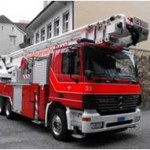
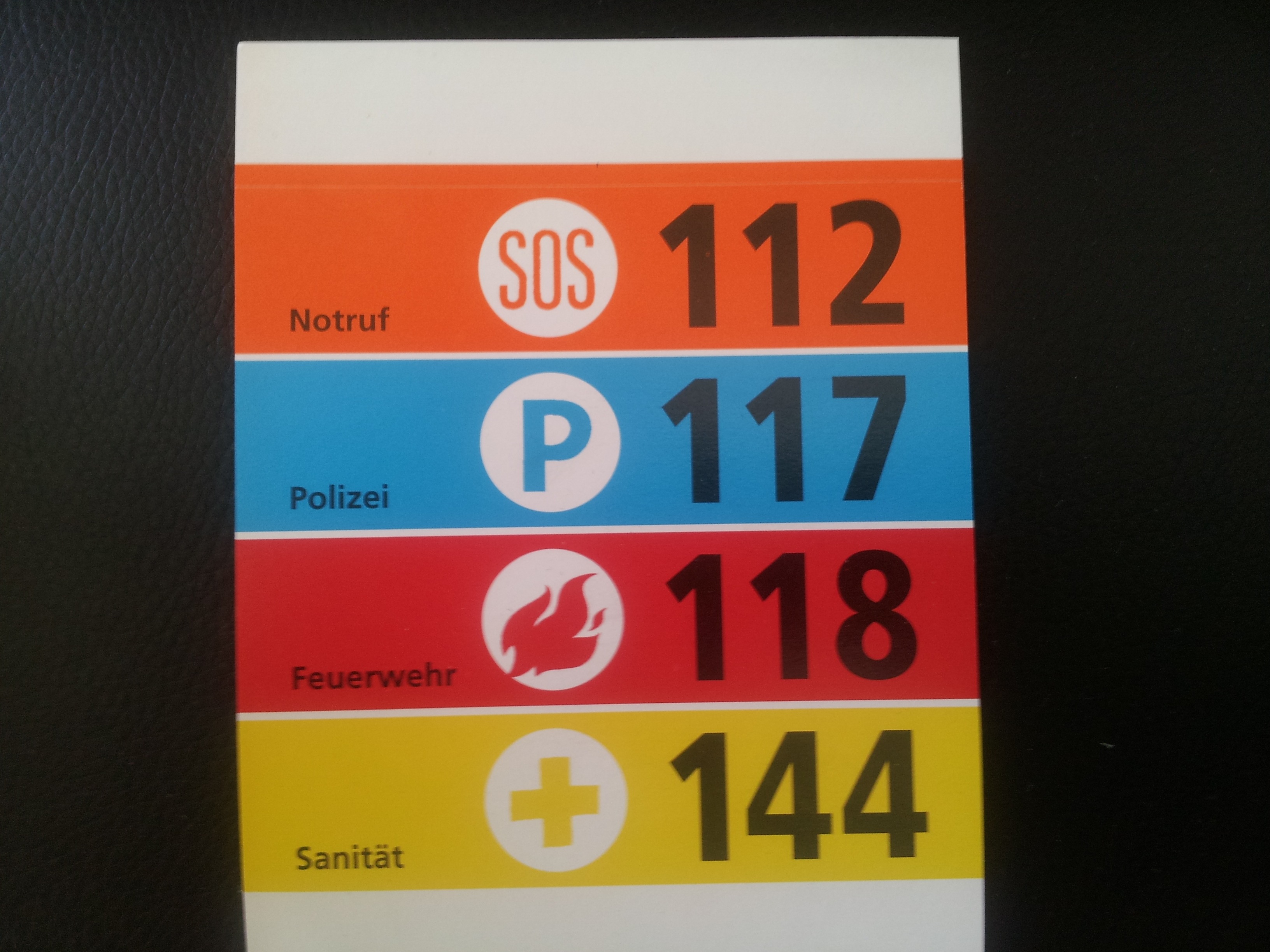
The general emergency number is 112. You can also contact emergency police, fire and ambulance services at their own emergency numbers.

The general emergency number in Switzerland (and many other European countries) is 112. You should memorize this. This would be the equivalent of 911 in North America, getting you to general emergency services (fire dept, police dept, emergency medical service), and should be taken as seriously.  You should be able to dial this from any working phone. Even mobile phones with a non-functional SIM-card have an SOS mode that should allow you to dial this.

In case of a health emergency that requires an ambulance specifically, you can dial 144, in Switzerland. Ambulances in Switzerland are probably not covered by your health insurance plan, at least not entirely. I’ve never had to use the ambulances here, but from people I know who have,  this is between 300-1800 CHF for a single ambulance trip, depending on how far away you had to be taken and what services are necessary! Check this with your Basel health insurance company, if you have questions about how much you are covered for, if you need to get an ambulance to the hospital.

Some other numbers that might be handy in other emergencies are: Police (Dial: 117) or Fire (Dial: 118) or Poison control (Dial: 145).

You can also go on your own to the emergency room of hospitals or clinics:

  1. University Hospital Basel (Universitätsspital Basel)
  2. University Children’s Hospital (Children’s emergencies)

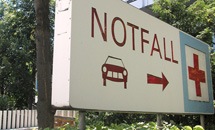
Follow the signs that say ‘Notfall’ (emergency)!!

This is the emergency room sign (notunfall) in Basel.
If you have an injury or illness that requires immediate attention, go to the emergency (Notfall) room of the hospital.


You’ll have to show proof of health insurance so be sure to have it with you. In fact, you should have your proof of insurance with you at all times, just in case anything ever happens to you and you require emergency medical treatment.


Is there a doctor in the house?

If your situation is not life threatening (or painful) enough to warrant an ambulance, or a trip to the emergency room you might still need a doctor.

The doctors that you are eligible to see, and how to approach them, depends on your health insurance plan. Be sure to check with your insurer to see how to proceed. If you don’t seek medical attention as described by your policy, you might not be eligible for coverage. For some policies, you need to see a GP before a specialist, others require a telephone call to a medical adviser before seeking out a physician. Once you figure out what medical plan you have, and how you need to proceed, choosing a physician can be another hurdle. You can talk to friend or work colleagues to let you know who they like or who they don’t. Alternatively, you can go online to look for physician reviews on sites like http://www.endconsumer.org or look on the English Forum in Basel.

If you work for one of the big companies in Basel and you need to see a doctor, ask if there is a on-site medical center.  You’ll generally be able to see the doctors and nurses there, free of charge.

Perhaps you want to go see a physician outside of work hours, or it’s Christmas morning or New Years Day and you’ve fallen ill. If you are not willing to brave the emergency room, there are some medical practices that are open outside of the standard working days. Medix Toujours is open 365 days/ year from 7am – 10pm. It’s a walk-in clinic for illnesses and injuries, where no appointment is necessary. Again, you should check with your insurance to see if they will cover you, but it’s nice to know that places like that exist!


Colds, scrapes and bruises, hangovers, etc.

The contact information for the Notfall Apoteke (emergency pharmacy) in Basel, Switzerland
If you need something from the pharmacy outside of normal opening hours, try the Notfall Apotheke on Petersgraben.

If you don’t think whatever is wrong with you requires professional medical attention, you might be able to find something to treat you at the local pharmacy. These are all over the place, and are generally indicated by a green cross on the shop, and the words Apotheke. They are located across the city and are open during the standard shopping hours. If you can’t make it during standard opening hours, there is an emergency pharmacy at opposite the University Hospital which is open outside of normal working hours and on weekends and holidays, and another one by the SBB which is open from 7-22 365 days a year. Over the counter drugs are more expensive in Switzerland, than in most other places in the world, so you might want to stock up on headache pills and cough medicine while you’re in another country!


Dental care

Taking care of your teeth in Basel.
Dentistry in Basel can be costly!! It might be better to schedule regular check-ups when you’re at home!

Like many things in Switzerland, dental care in Basel is great quality, but really expensive. If you’re an Expat, and you need the standard check-up/cleaning, etc. you might think of taking care of this in your home country when you go and visit. You can get supplementary insurance that covers dental, but it’s also costly. There are dental practices just across the border in Germany or France, when you can likely find dental work for less. If you decide to go to the dentist in Basel, or you need emergency dental work, I don’t have a recommendation for you, but talk to some of your friends or work colleagues, for recommendations or look on this recent thread on the English Forum. I’m not 100% certain if dental is covered in the case you damage your teeth by accident, so be sure to talk to your accident insurance provider regarding this (accident insurance is probably provided by your employer).

There is an excellent general health guide provided by the government which you should definitely download and have a look at.

I hope this post helps you find medical or dental assistance in Basel, Switzerland! Get well soon!!!


Sending your Children to School in Basel

I’ve had a couple of requests for this post, so I thought I’d give writing it a try. Seeing as I don’t have children, and didn’t grow up here, I’m a bit out of my element!

I’ve sent this post out to a few friends who have kids that grew up in Basel, who have looked in over (thanks guys!!), so hopefully most of the content is accurate! Remember, you should make sure you confirm this information with the schools or government! You should also talk to your employer, as some of the companies in Basel might sponsor your child’s tuition at a specified, private school.

From what I understand, the school system in Switzerland is Canton dependent  and not standardized across the country. If you move to Basel, you’ll probably live in Canton Basel-Stadt. I’ll try to keep my information confined to Basel-Stadt. If there is need for it later, I may write another post about the differences between the school systems in Basel-Stadt and Basel-Landt.

The school system in Basel has changed quite a bit over the last two decades. Prior to school reforms, the educational prospects of the children would be decided in their 10th year, and the children would be grouped into educational streams based on ability and preferences. Today, the children are still streamed, but this is done later in their education.

School in Basel
The schooling system in Basel might be different than what you’re used to. Be sure to make the right choices for your children!

Your child’s education is one of the key decisions you’ll make for them, so you want to be sure you are informed about the school system before you’ve moved to Basel, or as soon as you arrive. Where your children attend school, in part, will be determined by where your residence is located. All children in primary school, should be in attendance of a school within walking distance of their home, and they are often expected to come home for the lunch break.


Pre-School/Daycare in Basel:

There are numerous daycares in Basel, that will take children before they go into the regular, government school system. They take infants as young as 3 months old, toddlers from 2-4 years old and have kindergarten for children from 4-6 years old. These are privately run, and can be quite costly, depending on the facility and how many days per week you send your child for. There are German only daycare centers, English only daycares, and bi-lingual facilities which teach the children in two languages. I would imagine that you could also find daycare centers focusing in other languages.


The Compulsory Swiss School System in Basel-Stadt

There is a mandatory education period in Basel, which lasts about 11 years, including kindergarten. After this mandatory education period, your children will be assessed, and then continue education at various secondary schools or in vocational traing, based on the assessment of their skills and aptitudes.

The primary language spoken in the Swiss public school system is German, but support classes are available for children who have just arrived from non-German speaking countries. This is to get the children up to speed as quickly as possible, and allow them to integrate into school in Basel.


Kindergarten in Basel
Kindergarten in Basel, is for children from 4-6 years old, and is part of the mandatory school period. The Kindergarten curriculum is geared to learning through play and different sensory experiences. For expat parents, who don’t have exposure to German in the home, a kindergarten environment is ideal for their children to learn a new language. There are over 150 licensed kindergartens in Basel-Stadt, so hopefully you can find something for your children close by your residence.Moving to Basel eBook


Primary School:

From the age of 7-11, kids attend primary school. This is where they begin to learn reading, writing and the other academic skills they’ll need for the rest of their lives. Starting school at 7 years old is a bit later than what I’ve seen in other countries; however, you are free to teach the children at home or in private classes before this. The size of the primary school classes is limited to 25 children. The primary school system in Basel-Stadt is geared to expats, with intensive immersion courses in German offered, to teach children from other countries the German language as quickly as possible and then allow them to move into regular classes.

Allocation of grade level is very fluid in the Swiss system and takes into account a child’s abilities more than many other systems. As a result, children can move up or down a level and repeat years to allow them to develop optimally. It’s not unheard of for children enter classes a year below their age appropriate grade, to allow them more time to develop their language abilities. Children from other countries often have a few trial days and assessments when they start school, and will generally be given additional lessons, several times a week, to develop their German skills. Parents are provided with input into their child’s development through meeting and school reports. Traditional grades are not used at the primary school level.


Basel Orientation School
In orientation school, children are assessed for aptitude and performance, for later streaming

Orientation school 
Orientation school in Basel goes from the ages of 11-14. In these years, the strengths, weaknesses and preferences of the students are assessed. After they have been assessed, the children are streamed into different educational paths, based on their performance in Orientation School. They learn languages (German and French), Math, Sciences, History, Music. There are also large numbers of optional courses they can take.


After the Compulsory Education Period:

This is where it starts to get a bit confusing! Following the compulsory education period, students are divided into streams for further education, based on their aptitude in orientation school:  an A-Stream, an E-Stream and a Grammar School stream. Students are directed to the E-stream or the A-stream for two years, and to Grammar School for five years.


The A-stream        

The A-stream is a general level education, for students who are not academically inclined and who are assessed to be likely to succeed in apprenticeships and vocational certificate training.


The E-stream

The E-stream is for students who are at a higher level academically than their A-Stream peers, and provides a curriculum geared to more academically demanding apprenticeships and further education. Often, students in the E-Stream can study applied sciences at university after a vocational or specialist baccalaureate.

Students in the A-stream or E-stream can move to the grammar school stream, by passing in a qualifying examination.


Math in Basel
The stream your child is placed in will decide the subject of their future studies

Grammar school:

Grammar school (Gymnasium), is the education stream for strong academic students, leading towards the expectation of a university level education. Grammar school is for students from 14-19 years old (the 8th to the 12th school year). In addition to the broad range of academic subjects, students are encouraged, and expected to learn independently. Once they have graduated from a grammar school (around 18 or 19 years old), they receive a Swiss baccalaureate certificate (also known as a Matura / Maturität), which qualifies them to attend university.


Vocational Training:

In an apprenticeship, students learn their vocation through a combination of courses and on the job experience. Usually, vocational apprenticeships start after the 9th year of school, when the child is about 16 years old, and last between 2-4 years depending on the complexity of the vocation.

Upon completing their apprenticeship, the students receive a Swiss Certificate of Competence. If the student aspires to further education, after completion of their apprenticeship, they can improve their qualifications through further training and coursework, or take a vocational baccalaureate exam, allowing them study in the university system.


Private Schools in Basel:

If you choose to, and you can afford it, you can send your children to one of the many private schools in Basel and the surrounding area. There are international schools, that have children from numerous different countries, that are run in English or other languages. The schools meet federal standards and offer a wide range of courses, but are costly, and often have long waiting lists.

Be sure to talk to your employer about support that they might offer and discuss the ramifications of support for your family (i.e. if they provide support for two years, your children may need to change schools after this point, if you are unwilling to continue payment personally).

Good luck sending your children to school in Basel! If you have any further input that might be useful, send us a note, or leave a comment below!

Single in Basel? Easy Ways to Meet Someone Special

There are lots of ways to meet new people when you move to Basel, Switzerland
There are plenty of great ways to meet people in Basel!

Moving to Basel, Switzerland is going to be an exciting adventure for you, but it will also pose some challenges. If you are single in Basel, one of those challenges is meeting someone special. If you want to start a relationship, either casual or serious, you’re going to have to put yourself out there.

You can do this the traditional way, by going out and talking to people, taking part in social or sports clubs and activities, or hanging out at places where you might meet interesting potential partners.  Alternatively, you might go the internet route, where there are different websites available (some options discussed below) that can put you in contact with a person with similar attitudes, tastes and ideas. To maximize your chances of meeting the right person in Basel, you should try both the face-to-face approach and internet dating.

Basel is an excellent place for singles for several reasons:

  1. The city is large enough that there is always something interesting going on. You don’t always have to see the same people time and time again. Go to different places and you’ll meet different people
  2. The city is small enough, that if you meet someone interesting, and want to run into them again, you probably will. Many people are territorial, frequenting their same favorite places repeatedly. Spend enough time at the place you met someone, you’ll be likely to run into them again.
  3. As an expat, you’ll probably have the advantage of the ‘foreigner effect’. You’ll likely have a different background, traditions, and customs than many of the people you meet when dating. This gives you something to talk about when you meet someone, and gives you an appealing, exotic quality.
  4. There are always lots of new and interesting people moving to Basel, Switzerland on a regular basis, so you have a steady stream of potential new dating options.

Meeting Someone in Basel, Switzerland: The traditional way

You can go the traditional route, or online
Finding a love interest in Basel, Switzerland can be simple.

Depending on what your interests are, there are a wealth of bars, restaurants and clubs in Basel, where you can meet someone. I’m not going to give you a list of places to go, as I don’t know what you like to do, but there are a few things you can do to optimize your chances of meeting someone:

  • Whatever you look like, make sure you’ve made the most of what you have, and look your best.
  • Be sure your personal hygiene is up to snuff. Make sure to shower and if you’re using perfume or cologne, don’t use too much!
  • Be outgoing, friendly, and above all confident.
  • Go to events that encourage personal interaction, especially with strangers. Going to the movies is an unlikely place to find someone new to talk to!
  • It’s a good idea to showcase your special skills if you have any. If you’re a great actor, join a theater group. If you’re a fantastic singer, go to a karaoke night or join a choir. 

There is also your workplace to meet potential partners, but be careful here! Dating someone you work with, especially if you see them on a day-to-day basis, can be a strain on the relationship as well as being a very uncomfortable situation, if things go sour!

Meeting Someone in Basel, Switzerland: Online Dating

Online dating in Basel, Switzerland
Online dating in Basel is easy, and generally free to sign up for.

As people’s lifestyles become increasingly hectic, online dating makes more and more sense, and has lost any stigma associated with it over the last decade. I’m sure most of us know at least one couple who have met online. Whether or not you think dating online is for you, it’s like online shopping. It doesn’t cost you anything to sign up and ‘shop’ for a partner.

If you plan to go the online route, there are several options available in Basel, depending mainly upon what languages you speak, and what you want out of your relationship. There is no charge to do the initial registration and see if you can make a connection, so its best to apply to register with as many as you want to for free and then pick one or two that you might want to get a full membership to, depending on the interfaces, the people and connections you find, and the overall feeling you get from the sites…

Parship is the best online dating site for English-speaking expats living in Basel, in my opinion. The site has a large number of members and sign-up is free; that way you get to look around before you decide to go any further. You need to complete a personality test, which really helps to find compatible partners and to weed out the duds. Parship uses algorithms to help you, as a unique person, find meaningful relationships with others from all walks of life, based on key compatibility factors.
PARSHIP.ch - Die Online-Partneragentur

ElitePartner: Are you an educated, professional looking for a long-term relationship, that would like to meet others in the same situation?  Then you really need ElitePartner. The majority of ElitePartners members are university-educated, with an open and passionate approach to life.  The ElitePartner algorithms are designed to find long-term compatibility, and according to user surveys, over 40% of ElitePartner members with a premium membership will find a life partner through the site! The initial registration is free, and then you can decide later if you want to upgrade to a premium membership.

Looking for a same-sex relationship? If you’re part the gay and lesbian community and are interested in finding a same-sex relationship, there are specialized websites that focus on finding you the perfect partner. One of these is gayParship, an online dating website that sports a whopping 38% success rate of premium members finding the right partner for them!

I don’t want a relationship, just a fling!: The sites listed above are for people who are looking for a relationship that will (hopefully) be long-term.  What if you’re not ready for that kind of commitment? Perhaps the idea of one sexual partner bores you, or you’re in a difficult part of your life and don’t want anything too serious. Or maybe you just don’t have the time for a committed relationship. There are also online dating websites for both women and men looking for something more casual. Try the Secret.ch website if you want find a partner a casual encounter. With 850,000 members looking for uncomplicated dates and erotic encounters, you stand a pretty good chance of finding someone that suits your needs. The site prides itself on being safe and anonymous; its not available in English, but translates well in most web-browsers. 

There are other dating sites that operate in Basel, Switzerland or across Europe (remember France and Germany are just a short way off), so be sure to look around to find something that works for your particular tastes.

Regarding online dating, it’s important to be truthful in your profile, otherwise any connections you make are very likely to fail. Here are some things to keep in mind when dating online:

  • Post an accurate (but flattering), recent photograph. You don’t want anyone to be disappointed when seeing you in person
  • Leave some mystery. The most successful online daters are those who keep their profiles small, but impactful
  • Don’t make yourself out to be something you’re not. If you’re not funny, don’t say you are. If you don’t like the outdoors, don’t say you do. You get the point!

Once you do find someone who tickles your fancy, there are lots of great places to go to in Basel and things to do. But that’s a post for another day! Good luck finding someone in special to share your life in Basel!

If you have a good story or advice on meeting someone in Basel, tell us in the comment box below!

Are you in Zurich? Then try the Single in Zurich website!

Going to the Movies in Basel

Basel movies
There are lots of cinema options in Basel, both mainstream and independent.

Moving to Basel eBook

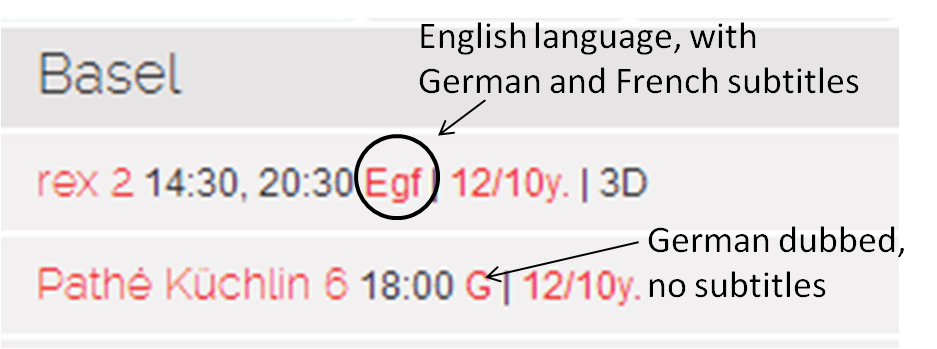
Basel has numerous cinemas, with both theaters that show the most recent mainstream movies, as well as more specialist movie houses that show independent and foreign films. You can find the Basel movie listings at the Cineman website or you can check the local free newspapers. In the summer, there are also open air cinemas, that allow you to enjoy the good weather outside while watching a movie.

Can I see a movie in English?

In Basel, you can find most movies dubbed either in German or in the original language (most often English). As Switzerland is multilingual, if you see a film in English, there will usually be French and German subtitles displayed on the bottom of the screen. This can be distracting initially, but you get used to it quite quickly, and after a while, don’t even notice it anymore! And, as an added bonus, it might also help you learn a little German or French.

Movie language and subtitles basel
The spoken language of the movie will be capitalized, subtitles listed in lowercase.

To make sure the movie you are going to is in English, look for the letters ‘Egf’. This means dialogue in (E)nglish, subtitles in (G)erman and (F)rench. Similarly, ‘G’ would be for a film dubbed in German with no subtitles, ‘Fg’ would be for a film with French dialogue with German subtitles, etc. Often, the Other papers and websites use ‘Original Version’ (Ov), ‘German Version’ (GV) or ‘French Version’ (FV). English and German dubbed films will be shown in the same multiplex theaters, so make sure when you buy your ticket, you’re going to the correct movie. The dialogue/subtitle designation is generally displayed by the movie showing times or next to the movie title.

How much is going to the movies in Basel going to cost me?

3D movies in Basel
3D glasses cost extra, but once you buy them you can use them for future 3D films in Basel.

Going to see a film in Basel is quite costly. A single, adult ticket generally costs 17-19 CHF, depending on where you go. If the movie you are going to is in 3D, you can add another few francs to the ticket price, as well as additional costs for 3D glasses (which you get to keep and can reuse) .

You are not allowed to bring food or drinks into most cinemas, and the snacks available are also quite costly. If you really feel like splashing out, some cinema’s have a VIP theater, where at an additional cost you sit in a separate theater, get a glass of champagne, some snacks and a more comfortable seat.

Some (but not all) movie theaters in Basel have an intermission halfway through the film, for about 10 minutes. This is an ideal time for a bathroom break or to get something to eat. If you plan to leave the cinema during this time, be sure to keep your ticket stub!

Where to see mainstream movies in Basel

Most of the ‘mainstream’ movie theaters are located in the same area, near Steinenvorstadt (between the Barfüsserplatz and Heuwagge tram stops). Below is a list of many of the mainstream cinemas in Basel.

Capitol – Steinenvorstadt 36, 4051 Basel

Pathé Eldorado – Steinenvorstadt 67, 4051 Basel

Pathé Küchlin – Steinenvorstadt 55, 4051 Basel

Pathé Plaza – Steinentorstrasse 8, 4051 Basel

Rex – Steinenvorstadt 16, 4051 Basel

Studio Central, Gerbergasse 16, 4001 Basel


Where to see independent and foreign movies in Basel

The Kult Kino theaters (http://www.kultkino.ch) are the local arthouse cinema in Basel. They show the movies in the original language with subtitles in different languages. They have English language independent and ‘brainstream’ films from around the world. There are also other independent cinemas also listed below.
kult.kino atelier – Theaterstrasse 7, 4051 Basel

kult.kino camera – Rebgasse 1, 4058 Basel

Neues Kino – Klybeckstrasse 247, 4007 Basel

Stadtkino Basel – Klostergasse 5, 4051 Basel

Outdoor movies in Basel
Open air kino (cinema) in Basel is popular in the summer.


Open-Air Cinema

During the Basel summer, there are open air screens in numerous outdoor locations. The Open Air Cinema showings take place in July and August, showing movies at Münsterplatz. The Neues Kino shows movies on a grain silo in the Rhine harbor. Some of the local outdoor swimming pools/garden parks also have outdoor film nights. Showings are weather permitting, so hope for good weather!

We hope you enjoy going to the movies in Basel!


Keeping in Touch with Home as a Basel Expat

Moving to Basel eBookWhen I first came to Basel (for what I thought was just a year), in 1998, it was my first time really away from my friends and family back home. Sure, I’d gone to University in a different city, but moving to a foreign country, with a different language was disorienting to say the least! Not knowing anyone outside of work left me lonely and missing home. I’m not sure if you’ve ever been through something similar, or are maybe experiencing it now, but keeping in touch with people from home can be very comforting to the homesick expat!

Whether you know people in Basel or not, it seems likely that you’ll keep in touch with people from home. However, no matter how good your intentions are, it’s important to realize that you won’t be able to give the same amount of attention to some of your relationships as you did before (and to not beat yourself up about it!). You’ll be meeting new friends, the time difference might hinder your efforts to communicate, and keeping in touch can be expensive, not to mention time consuming. This post discusses different ways of communicating with the gang back home.

Telephone

When you move to Basel, you’ll no doubt arrange for a mobile phone and perhaps a land line. Phone is the most obvious way to keep in touch, but it’s certainly not the most economical! For both a land line and mobile, you’ll have to pay a monthly fee for your phone contract, and while you’ll likely get some free minutes and text messages, it’s a good idea to check your plan carefully, as free minutes often don’t apply to calls and texts outside the country. One way to keep calling costs to a minimum is by using international phone cards. Some phone companies also offer International Direct Dialing (IDD) packages where you pay for a set number of international call minutes. In Basel, these are available at numerous stores throughout the city and are often clearly displayed in shop windows.

Telephone Basel
Keeping in touch from Basel

Instead of a contract, you can also get pay-as-you-go phone where you re-load the card with credit by purchasing reloads available at most local shops or by having the pre-pay SIM card, linked to your credit card. Don’t forget to think about the time difference when you’re calling internationally…if you accidentally call someone at 3am, you’ll scare them to death!


Voice over internet calls

One of the more recent, least expensive and most personal means you can use to keep in touch are voice over internet service providers (VOIP).  These services allow you to speak with people via the internet, with the option of seeing them on video, often free of charge. There are free services available such as Skype, that can be upgraded for a fee. There are also providers who charge for additional features and support services. You’ll need a broadband internet connection, a microphone and speakers (most laptops have these built in) or a headset and a webcam.

While video calling over the internet is very personal, it still feels kind of like a phone call. You have to keep in mind, that the person you are talking to can see you, forcing you to curtail some of your ‘telephone habits’ (like rolling your eyes when someone says something irritating), walking around and multitasking while you talk. Taking a video call in the WC is also a bad idea.  Video calling also provides interesting venues for long distance romantic relationships; be careful though, it’s remarkably easy to record a video of onscreen happenings.

Emails

Almost everyone (including my 70+ year old parents) have access and can use modern email programs, making it easy to keep in touch. Depending on how fast you type and your ability to express yourself in writing, emails can be an excellent way to keep in touch with almost all your friends and family. You can also send blast emails or a newsletter attachment to long lists of friends family and acquaintances, though this is usually perceived to be less personal, than even a short email to someone in particular. Email is perfect for transcending the timezone issue that makes it tough to  keep in touch. If you don’t already have an account, you can sign up for one for free at Hotmail or Gmail.


Social networks

Social networking sites like Facebook, are great for keeping in touch with family and friends, in an informal manner, as well as to keep in with less important acquaintances that you have lost touch with. Social networks can be used to update people on your location and what you’re doing, to share photos, organize events for when you come home and to send private or group messages. Be sure to adjust the privacy settings on your social network to control who can see you profile, and how much information you want to share with the world.

Platforms like LinkedIn can serve the same function for current and former business colleagues, back home. Many people check social media networks on a daily basis, making them perfect for keeping people abreast of your activities without necessarily contacting them directly, and vice versa!

A blog is short for a ‘web-log’, which is a simple online way for you to keep and share a record of your experiences in a more detailed, thoughtful manner than on a social network. A blog is easy to set up, low cost and the perfect platform for you to share your thoughts, feelings and impressions of your time in Basel. You can share your blog publicly, with a select group of viewers, or you could keep it private, for yourself only. Blogs allow maximum freedom online to share photos and video.

There are lots of blog hosts available. The two that I’ve had the best experiences with are Bluehost and iPage. These have relatively similar functions, and offer really simple blog building tools.  I’m using Bluehost for this page at the cost of about 5-6 dollars a month. They offer free installation of WordPress, which is a really user-friendly blogging platform for free, as well as options for other site building tools. I like both these providers so much that I decided to become an affiliate, which means if you click on the links for Bluehost or iPage, and decide to set up an account, I’ll receive a small commission, at no cost to you.


Instant Messenger Services

These programs allow you to text chat in real-time with your friends and family back home. You can have a conversation typing messages back and forth. Instant messenger services are already integrated into social medial platforms like Facebook, as well as into free email services like Gmail and Hotmail.


Sharing photos

With most mobile phones being cameras, and all the new things for you to see in Basel, pretty soon you’ll have gigabytes of photos. High resolution photos are large files, and it can be hard to send all of these in an email due to size restrictions. One way to overcome this is to make an online photo album to share with your loved ones. Then you can email out a link to anyone you think may be interested, and give your photos a password, so that they are not visible to the public. Smilebox is one of these providers, but there are also many other such services.  Some of these also allow you to add music and captions to you photos, turning them into a digital scrapbook.


Sending gifts home

If you can’t make it home for that special someone’s birthday or for the holidays, you can send back gifts instead!  However, mailing packages from Basel is very expensive; as often as not, posting even a small gift costs more than the price of the gift! While less personal, shopping sites like amazon will let you send your gift directly to the house of the people you care about. For additional costs you can also have them gift wrap it and include a note! Amazon has sites based in many countries, so you can have your gift shipped directly from a distributor located in your country of choice.  This will save you international postage and handling costs, as well as customs fees.


Posting letters and cards

While phones and computers are the most efficient way to keep in touch, I think that everyone in the world loves to receive a letter or a card by traditional post. You should always do these by hand (not typed then printed) to give it that personal touch. It’s harder, because you can’t edit, delete or change things, but sometimes the nicest way to communicate is to see someone’s raw feelings being expressed, without too much revision. While everyone loves to receive a letter, they are time consuming to write, so you may want to save these for only the most special people in your life, or for special occasions. Letters are also a great way to keep in touch with people without a computer. Getting a return letter back from your loved one in the post will also make your day!

There are numerous post offices across the city, and letters are not too expensive to post. You can send two kinds of letters, Priority or Economy internationally. As the names suggest, Priority mail will cost more and get there faster, while Economy mail will be less expensive, but slower. Many of the clerks at the post offices speak English, and will be able to tell you the cost and approximately how long a letter will take to reach you particular country for each type of mailing option.

I’m sure you have other ways to keep in touch with friends and family; please feel free to share them in the comments section!

Moving to Basel – Part IV: Setting up Internet, TV and telephone services

So, you’ve finally got your furniture, appliances and electronics all set up in your shiny, new flat . Now, you’re almost done, you just need to set up the cable, internet and a phone line!

I’ve summarized what I know about some of the different options out there, and included links to the sites for each, but  don’t listen to me, make sure your check them and other options out for yourself.

Setting up internet, TV and land line telephone

Once you’ve moved into your new place, you can organize an internet connection, cable/digital television and a telephone land line.  The costs for each of these depend on what your personal needs are. You can find separate providers for each service, but most of the time, it’s more convenient and less expensive to get a package deal for some or all of these services, if you’re planning to get more than one.

All in one providers

UPC Cablecom

UPC Cablecom in Basel provides digital broadband Internet, digital telephone and digital TV services. I’ve been with UPC Cablecom for years now, for all three of these services, with very few problems. I use the internet extensively, and need reliable, fast broadband. My girlfriend likes to call home (the UK) a lot, and we both like to watch UK TV stations (Swiss TV is an acquired taste).  All of these services have been very reliable with UPC Cablecom, and when there are issues with technical stuff, their customer service department is fast, efficient and best of all friendly, pleasant and polite.  Most of the customer service reps speak English quite well, or will put you on with someone that does.

A really big plus is that UPC Cablecom’s website is in four languages, one of which includes English. This lets you make an informed decision about what you want to order.  The prices are pretty reasonable. For high speed internet (but not the highest speed), a land line and digital cable with about 25 decent English-language channels and digital video recording, I pay around 100 CHF for all three (not including costs for phone calls). I think when you sign up it might even be a little cheaper for the first few months. UPC Cablecom also has mobile phone offerings.

Sunrise

Sunrise provides fixed lines, mobile phones, and more recently, internet and television. My mobile phone provider is Sunrise, and has been for at least 7 or 8 years now. I signed up first as a pay as you go customer, then moved over to a contract with a data package, when I got a smartphone. Like UPC Cablecom, most Sunrise customer service reps speak English and their website is also available in English. The service I’ve gotten from them has been quite good; nothing really exceptional, but strong enough not to lose me as a customer for almost a decade!

Swisscom

Swisscom also has package services. I only used Swisscom for my land line in 1998, and again a few years ago for my work mobile phone, so I can’t say I have that much experience regarding their more recent products. From a look at their website (which has English as one of the languages), they seem to be similar in price to UPC Cablecom, or Sunrise.

For UPC Cablecom, Sunrise and Swisscom, you can pick different combinations of any of these services, as well as single services, so have a look at both and see what’s best for you! Want to compare all the services without exploring each website individually, before you make a choice? Try going to Bonus.ch, a price comparison website that will allow you to see which provider will give you the best deal. Unfortunately, its only in German, French and Italian, but it translates pretty well using your brower translate function (try right clicking and then selecting translate to English from the menu, while on the site).  You enter your email address and they send you the comparison info.

Prepaid  and budget phones

Prepaid offers are available from all main mobile providers (Sunrise and Swisscom). Generally, for these you need your own mobile telephone. Be careful, as some phones you buy are SIM-locked, and you won’t be able to use them with all providers; make sure you ask the salesperson about this when you get your phone. You can get a prepay SIM-card from the provider of your choice (which is associated with a phone number). In most cases, you can link the account to a credit card, and/or purchase refills for the prepay card in different shops and kiosks. The nice thing is that you know when you’ve reached your set spending limit, as you won’t be able to use the phone for paid services after this point. Of course, the negative is that having your phone stop working when it runs out of credit is terribly inconvenient, when it happens in the middle of a call, in an emergency, or when system issues prevent a prepay reload. On a budget? Try a Yallo Prepay phone.

Phone contracts

Contracts or subscriptions for your mobile are available from each provider with different service options, for different durations (usually 12 or 24 months), for various prices. It’s good to have a realistic idea of how much you talk on the phone, how much you text, and how much data usage you go through using the internet on your phone, in order to choose a plan that works for you. Often the a discount or even free phone will come with the subscription. Many plans allow subscribers to turn in their old phone after a certain time (usually 1-3 years), for a newer model.

TV and Radio reception feesMoving to Basel eBook

Before you invest in these services (especially a television and cable) there are a few things you should be aware of.  If you are able in any way to receive TV (or radio) in Switzerland, you are obliged to pay a television reception fee (around 25 CHF/month) and a radio reception fee (about 15 CHF/month). There is a webpage answering FAQs on this subject, which should cover most questions you have. Keep in mind, it does NOT matter if you actually listen to the radio, or watch the TV. The fact that you have the ability to receive these, means you have to pay these fees. In fact, even if you don’t have a radio or TV at all, but have a computer or even a mobile phone that is capable of receiving radio stations, or playing video, you have to pay these fees.

The company Billag AG, is the collection agency for these fees (the site is in English) and their website also has infomation on fees. You definitely need to pay these fees, as they send inspectors around, unannounced, to all homes and apartments. The Billag AG representatives will knock on your door, and check if you have access to radio and TV. If you haven’t already registered these services, they will bill you retroactively, based on when you should have been paying, and possibly fine you.  Registration can be made online or by telephone (+41 844 834 834). If you can’t navigate the online registration form because of the language issues, use the translate function available in most browsers, get someone to help you or call Billag AG see if you can find someone to answer your questions in English.

Good luck getting your services set up! If you know beforehand where you’re going to be living, you can contact these companies to get things rolling well before hand, so you have everything ready for the day you move in.

Garbage Disposal and Recycling in Basel

Moving to Basel eBookOne of the first things I noticed when moving to Switzerland, was that garbage and recycling were on a whole new level of complexity compared to what I was used to in Canada! Hopefully, this post will be able to answer some of your questions on the topic. I’m not an expert in this area, I’m just passing on what I’ve learned over the years, so if you have additional questions, you can call the Basel Cleanliness Hotline (+41 061 385 15 15), or look on the city website (this is currently only in German, but it translates well in Google Chrome). Feel free to make comments with any additional information at the bottom of this article; I’m sure future readers will appreciate it!


Standard Garbage

When I first came to Switzerland in 1998, I tried to put out my garbage in a standard black garbage bag. On garbage pick-up day (which generally occurs twice a week), my garbage was left on the curb, with a sticker on it, explaining that it needed to be in a special blue garbage bag called a ‘Bebbi Sagg’. I asked one of my neighbors and they told me that I could pick these up at my local grocery stores (Migros or Coop), at the cigarette and alcohol counter. What my neighbor didn’t tell me, is that the cost of these bags incorporates the taxes for garbage pick-up, and they cost an insane amount of money (10 x 17 Liter bags for CHF 12.00, 10 x 35 Liter bags for CHF 23.00, 10 x 60 Liter bags for CHF 33.00).

Basel Bebbi Sagg
The Bebbi Sagg is the official garbage bag for Basel-Stadt. They are available in 17L, 35L or 60L sizes.

After getting over the initial heart-attack of paying for them, I realized the idea was brilliant! This high cost acts as a deterrent to creating waste, and proportionally taxes those that produce more garbage. As the money for the garbage bags is so high, you generally try to minimize waste production and recycle materials where possible, instead of throwing them in the trash.

Your official blue Bebbi Saggs should be put out the night before garbage pick-up, after dark. If you put your garbage out too early (or in the wrong bag) you might be fined. These fines run into the hundreds of Swiss Francs range, which explains why Switzerland is so clean! The pick-up days are defined by which zone of the city you live in. You can accurately find your zone by inputting your address into the zone calculator.


Recycling Cardboard and Paper

It doesn’t cost anything to recycle paper and cardboard, but this must be done in a very specific way. It needs to be tied up with twine, in strings packages that have a maximum volume of about 0.5 m3. I’ve tried taping the paper and cardboard with packing tape, or putting it all into a paper bag to have it collected, but have had this rejected. The string is the only way to go here, or your recycling will be left on the street with a sticker letting you know how to do it right! Paper/cardboard pickup day comes every 5 or 6 weeks. You can find the schedule of waste removal on the city website.


Glass Bottle and Aluminum Recycling

The system for recycling bottles and cans is much less convenient than the garbage pick-up! Basically, you have to take your bottles and cans to a local recycling area (there will probably be one within a 10 minute walk of your flat), sort it yourself into aluminum and by different types of colored glass (clear, brown and green). You can also dispose of old alkaline batteries for recycling in the small yellow boxes.

A standard Basel recycling station
Recycling stations have bins for aluminum, glass (clear, brown and green), as well as for batteries. They are open Monday-Saturday from 7am-7pm.

The real challenge is that this can only be done at specific times, from Monday to Saturday from 7am -7pm, and definitely not on Sundays! If you recycle outside of these times, you are very likely to have someone on the streets shouting at you, and if there are police nearby, there will definitely be a fine!


PET Plastic Recycling and White Plastic Milk Bottles

PET plastic bottles do not have a deposit in Switzerland. These are not to be thrown out in the blue bags, nor can they be recycled at the standard recycling stations (I don’t know why not!). PET plastic must be taken to the local grocery stores to be disposed of there. Plastic bottles should be crushed, to squeeze the air out of them, with their caps on top to keep them from expanding again. Usually you’ll see a box to put the bottles in, or some sort of a machine to take the bottles. The same holds true for white plastic milk bottles.


Electronics disposal

Your old TVs, VCRs and any other electronics you want to throw out can’t be disposed of by standard methods, but can be taken to any electronics shop, like Interdiscount or MediaMarkt for disposal. Just ask the staff in these stores, and they will tell you where you can put your old electronics.


Metal, Ceramics, Organic matter, Large and Small Miscellaneous Items

All of these have pickup dates that are defined by the city, depending on which zone you live in (check the zone calculator here). For large or small miscellaneous items, (ie a chair or a sofa), you need to go to a kiosk and buy a stickers that you can glue on the materials. Some people will put out articles that need to be disposed of outside, without stickers, some days before the pickup, in hopes the articles will be picked up off the street. If you are caught doing this, you’ll be fined or worse! The details for how to get rid of these materials can be found on the city website. If you have materials in these categories to be picked up you need to sign up online so that the city knows they are there.

I hope this helps to answer your questions regarding the complexities of getting rid of your trash in Basel! If you have further questions, be sure to call the Basel Cleanliness Hotline (+41 61 385 15 15) for clarification.

The Moving to Basel eBook – A New Resource for People Moving to or Living in Basel

Hi Everyone!

ebook cover

I hope you’re enjoying the site so far and have found some of the information handy! I’ve been getting a lot of emails and questions asking more specific questions. I was talking to a friend and he mentioned that people aren’t necessarily online all the time, and that I should create something that people can use both when they’re connected or offline.

After some thought and research, I decided that I could do this best using an e-book format. So I wrote a book all about moving to Basel! I researched for ages, wrote a lot of new material, reorganized the articles already on the site and created an information packed document to be a comprehensive, stand-alone resource that you can own and use both online and offline.

The Moving to Basel eBook has brand new chapters not available on the Life in Basel website:

Getting Around Basel

  • Riding Your Bicycle in Basel – Not as simple as it sounds and you can get  fined and your car license revoked if you do it wrong!!
  • Driving in Basel – What you need to do to drive in Basel and where you can find drivers training..
  • Being a Pedestrian in Basel – It sounds simple but in Basel there are rules!

Day-to-Day Living in Basel

  • Grocery Shopping in Basel – Shops, loyalty cards and for those to busy to shop, grocery delivery services in Basel!
  • Shopping in Basel and Across the Border – Shopping centers and how to get your taxes back if you shop in Germany or France!
  • Practicing your Religion in Basel – Places of worship and religious organizations in the city for all faiths.

Culture in Basel

  • Museums in Basel – Basel has more museums than you can imagine; this is a guide to most of the local ones…
  • Live Music in Basel – There are so many different live music venues in Basel, you need help to find what you like!
  • Theater and Dance Performances in Basel – Where can you see plays, musicals and other performances? Loads of places…

Fun in Basel

  • Dining out in Basel – An extensive guide to over 45 Basel restaurants for anything you’re in the mood for, whether its a casual meal or something really special…
  • Drinks in Basel – Feeling thirsty? The places in Basel with the best cocktails, wines and beers!
  • Cool Things to do in Basel – In the spring, summer, fall and winter…

Sports in Basel

  • Playing Sports in Basel – Gyms, sports clubs and equipment for the athletic types
  • Watching Sports in Basel – Where to see live or televised sporting events in the city

Pets in Basel

  • Bringing your Pets to Basel – What you need to know about vaccinations, microchips and registration if you plan to bring a pet…
  • Flying your Animals to Basel – Transport regulations for cages and shipping your animals.
  • Owning a Dog in Basel – Owning a dog in Basel might be more complicated than in your home country! This is what you need to know!

Bad things in Basel

  • Crime in Basel – Basel isn’t a perfect place. You need to be careful of crimes and might want to avoid some places…
  • Drugs in Basel – Basel has it’s share of junkies, and drug users; this will tell you about how to navigate the city safely.
  • Other Negative Aspects of  Basel – Discrimination, prostitution, incessant construction are all discussed in this section.

Work and School

  • Companies in Basel and the surrounding area – Links to company websites in the banking, pharma, medical, fashion and other industries.
  • Paycheck Deductions – Think you know your monthly salary? See where your money goes to, and what this is for…
  • Going to University in Basel – Basel has an excellent university. This section gives an overview of the different programs available.
  • Masters and Doctoral Degrees at UniBasel – Looking for an advanced degree? This is what Basel has to offer!

Each new topic is covered in as much detail as on the website. I’ve also included a short English to Swiss German phrase book to help get you started on you Swiss-German!

I really want you to try the book, so to encourage you, I’m offering a 60-day money back guarantee!  Buy it, try it, and if you’re not entirely satisfied, I’ll refund your money. Just like that. The book is only 11.99 USD to start with so your risk is minimal.

It’s also got all the content from the website, so you can refer to it, even when you don’t have access to the internet. Keep a copy on your tablet or smartphone so you have it at your fingertips whenever you need it.ebook cover 2

  • Getting a Job in Basel
  • Registering with the Canton
  • Health Insurance
  • Getting Sick in Basel
  • Finding an Apartment in Basel
  • Furnishing your Basel Apartment
  • Setting up internet, TV and telephone
  • Sending your Children to School in Basel
  • Using the Trams in Basel
  • Setting up a Bank Account
  • Taxes in Basel
  • Garbage and Recycling in Basel
  • Keeping in Touch with Home
  • Being Single in Basel
  • Going to the Movies in Basel

For those of you who have been enjoying the Life in Basel site, I hope the website has been helpful for you! Please try the eBook; your purchase will also help to support further new posts on the site, in the future.  I’ll also put you on my list for when I update the book and it’s links in future editions, so you’re always up to date! And if you don’t think it’s worth it, you can return it for a full refund.

For those of you who have just stumbled across this page while trying to get their questions on Moving to Basel answered, surf around the site and see if you like the information provided on the website, and the format its in. If you think its useful and informative, then try the book. I think you’ll be pleased! If you buy it and don’t like it, I’ll refund your money. The alternative is to spend hours and hours searching for the info across the web, and try to sort out what is correct! Is 11.99 USD worth saving many, many hours of frustration?

buy button11.99USD

Thank you for all your support! If you have questions, or ideas for future posts, contact me at admin(at)lifeinbasel.com!

Enjoy your life in Basel!

logo plus name 279x55


Guest Post I – The View of a Swiss Local on the Expat Community in Basel


Moving to Basel eBookOne of the things I’ve been looking forward to is having some guest posts from people who can provide insights into things that I have no knowledge about.


I was going to put a request for people to write on some specific topics for Life in Basel, but then a funny thing happened…some people approached me with great ideas for posts for the site!  


One of these people was Caroline, who had a website called Expat in Basel. Caroline and I decided to trade posts, where I’d write on my experiences in Basel when I first arrived, and how I feel about the city now.


As Caroline grew up in Basel, I was interested in how the locals view us, the Expat community living in Basel…below you’ll find her thoughts on connecting and interacting with the Swiss community:


Guest post for Life in Basel


Hi! My name is Caroline and I run the website Expat in Basel. I was born in France (just at the border in St.Louis) but I did grow up in Basel and area and I do have a dual citizenship, so I’m almost a Basel native.

LifeinBasel.com, asked me to write about how the Swiss locals perceive expats, and what the expat community can do to integrate and be accepted.


Tell stories and be friendly

Your big plus as an Expat living in Basel is you’ll always be interesting for the locals. They are very keen to hear about your home, travels and all your adventures. Most locals, who don’t come around much, are seeking opportunities to speak English, learn more about the rest of the world and interact with foreigners.


Talk to the locals

All you need to do is get out of your comfort zone and try the unknown (I know, you already did that by moving here). What I mean is find places to go and meet new people that are from the Basel area.


Try out your German skills

And if by any chance you do feel comfortable testing out your German, do it, (even better if you want to try Basel Swiss of course!) and you’ll see how thrilled your counterpart will be in hearing that you actually try. We know German is a hard language to learn which is why you’ll always be received with a smile if you try. And if it makes you feel any better: I don’t know any Swiss person who actually speaks proper German. We’re just unable to do so and our accent is the worst you’ll ever hear when we try to speak German. So don’t worry about your pronunciation or accent!

Swiss German might come to you naturally, after a while, but nobody is expecting you to either understand, let alone speak it. I have a friend; she’s an Aussie and lived here for many years, married with children. She’s fluent in a mixture of German/Swiss German and that didn’t come over night. So take it easy and don’t be too harsh on yourself. Give it a try, even if it sounds wrong to you, it will sound more charming than you can possibly imagine to the person you’re speaking to. You would never laugh at anyone trying to speak your language, why should the Swiss do such thing to you?


Bars: Where locals and expats can connect

Photo of Paddy's in Basel, Switzerland
Paddy’s in Basel has a great mix of locals and expats, delicious food, and tasty drinks!

If you have children, go visit the Unternehmen Mitte they do have children’s afternoons on most Wednesdays (check their website or stop by to see the program on the posters) that’s a great spot to meet local Moms and maybe get a chance to not only meet new people but practice a bit of German. And if you want to really integrate into the local community, put your kid in a public instead of an international school. If you don’t have kids but would like to mingle with the locals, as silly as it sounds, I’d recommend Paddy Reilly’s . There are tons of locals who just love their Guinness. They are more than happy to speak English and maybe over a pint or two, you’ll find your way to hang with the local crowd and make new friends.


Learn to cook

And if you like to cook go visit Savoir Faire’s  website every once in a while. They organize cooking classes for Expats and locals. The past ones have been a great success and some nice friendships have been made there.

In general, as long as the Basel native can see you’re actually trying to reach out and that you are no alien they’ll be bombarding you with loads of questions. Don’t be offended about any prejudice they might have. They most probably assume you’re a millionaire and don’t do anything yourself but swim in your cash and enjoy life. And that opinion is only sticking around because of some huge Pharma firms that have CEOs making loads of money and claiming to only find good staff outside of Switzerland.

It’s like everywhere else in the world: you always need to get to know people before you can become friends. The Swiss are no different at all. They might just be a bit shy at first.

And if you do have any questions on Basel or the people, don’t ever hesitate to drop me a line  at info@expatinbasel.com

Enjoy Basel! Enjoy Switzerland and all it has to offer!
Caroline


Thanks, Caroline!!  Feel free to leave comments for Caroline below; we’ll make sure she gets them.  And if anyone has something  that they think would be of interest for the site (i.e. for people who are thinking of moving to Basel, Switzerland or for those who have newly arrived), please don’t hesitate to get in touch: admin@lifeinbasel.com! If we think your idea is a good one and you are a good writer, we can talk about you writing a post for Life in Basel!

Expatriate Medical Insurance in Switzerland

Moving to Basel eBookSwitzerland as a whole has excellent healthcare facilities, emergency services and outstanding medical staff, and Basel is no exception. One reason for this is that basic insurance health insurance in Switzerland is mandated by law. Upon moving to Basel, it is compulsory to choose a provider and take out health insurance within three months of arriving in Basel.

I came from Canada, where healthcare is free and universal, so the Swiss medical insurance system was a confusing for me, due to the wealth of different providers and expatriate health insurance plans available from each. I thought I’d do my best to explain the system to you, so that you have an easier time than I did! I’m not an insurance expert (take this as my disclaimer), so be sure to do your own further research to get the coverage that best fits your lifestyle!

Everyone who lives in Basel (or anywhere else in Switzerland) must have a basic health insurance plan (Soziale Krankenversicherung). In addition to expats and their families getting health insurance within the first three months in Switzerland, newborn babies must also be insured within three months of birth. Furthermore, partners and children should be insured individually, as they are not necessarily covered by one person’s plan. You need a reliable provider and plan that comprehensively covers you and your family for any unforeseen health issues that come up.

Which health insurance provider is acceptable is highly regulated by the Swiss government. Swiss officials involved will often not accept global health insurance policies, even if they provide coverage in Switzerland. There are numerous state-run Swiss insurance companies from which you can obtain health insurance that will satisfy the law.

If you’re looking for Household insurance, third party liability, life insurance or motor vehicle insurance information, this link will take you to the post on that.


Accident insurance vs. Health Insurance

In Switzerland, there is an important distinction made between accident insurance and health insurance. Accident insurance covers emergency situations that occur unexpectedly. Health insurance covers illnesses, from colds to cancer.

By law, your employer is obliged to provide employees with accident insurance (UVG – Unfallversicherungsgesetz). You don’t get a say in the provider of this accident insurance. The costs are split between employee and employer, and are generally automatically deducted from your pay. Accident insurance covers accidents both during and outside of working hours. The coverage includes reimbursement for care services, other accident-related expenses, and provides a daily allowance, if you are temporarily unable to work. The same insurance provides a pension, in case you are permanently incapacitated. If you decide to become self-employed, you can get accident insurance from your health insurance provider.

The specific details of an accident insurance policy differs for each company policy, and covers most situations, but may not cover high risk activities (off-piste skiing, mountain helicopter airlifts, extreme sports, etc.), so be sure to check! It also may not be valid outside of Switzerland, so be sure to check your policy before you travel abroad, either for work or holidays.


Deductibles and Co-pay for Swiss Medical Insurance

Depending on the plan you take, the deductible for your insurance is variable, between full coverage and a 2500 CHF deductible. Basically, the lower the deductible, the higher your premium is. The insured person is also generally charged a 10% co-pay (the patient pays 10% of the total treatment costs, even after the deductible is payed ) up to a maximum predefined level per year (usually about 700 CHF, on top of the deductible).

While the system may seem overly complex and a litte unfair, it has the advantage of preventing abuse of the system, as the patient always has to bear some level of cost for treatment.


Choosing an Expatriate Medical Insurance Provider

Choosing your Swiss health insurance provider depends on what you want out of your coverage, and how often you generally go to the doctor. If you rarely see a physician, and are not prone to frequent illness, you might consider a low cost insurance, with a high deductible. If you have a chronic illness, you might consider a plan that has a lower deductible. There are convenient comparison calculators online where you can explore different plans. This will depend on your Swiss postal code (4 digit), your age, and what kind of plan you want, Standard, General Practitioner, HMO or Telmed. A brief description of each is below, with a more detailed description here.


  • Standard Basic Health Insurance

Standard basic health insurance is the compulsory health insurance provided by all Swiss health insurance companies. The benefits are identical irrespective of the health insurance company. It is possible to consult the doctor of your choice.


  • The GP Model

In the GP model, the patient must always contact his GP upon becoming ill, unless it’s an emergency (as defined by the insurance). The GP is selected from a list provided by the insurance. The GP will decide whether or not the patient is referred on to a specialist.


  • The HMO (Health Maintenance Organization)

In the HMO model, the policyholder is obliged to consult a certain physician at an HMO centre, upon becoming ill, unless it’s an emergency. The HMO physician gets paid a flat monthly rate for all treatment his patients get. The flat rate makes it the best interest of the HMO physician to restrict treatment to only what his patient really needs.


  • TELMED

Telmed policyholders call an information line before going to the doctor. The telephone service will give information about what to do, or tell the policyholder to go to the doctor or the hospital. A telephone consultation is unnecessary for emergencies, and some other types of examinations.


Students, Researchers, Interns and Au pairs

There are also providers that cater specifically to students, researchers, interns and other trainees and au pairs. The insurance is generally lower cost, and meets the minimum legal requirements, but is only available with evidence of eligibility.


Supplementary Insurance / Top-ups

This type of insurance coverage is voluntary and provides a higher level of services (i.e, a private hospital room, instead of a shared room) or additional services (homeopathic treatment, dental care, contact lenses.). Premiums are often based on the risk to the health insurance fund, and they can refuse to insure depending on their health.


Ambulances

This is an area where you have to be careful! With basic insurance, the insurance company pays 50% up to 5000 CHF per year for emergency transport, meaning you have to cover 50% of the bill! From people I’ve talked to, this is between 300-1800 CHF for a single ambulance trip, depending on how far away you had to be taken and what services are necessary! If you have a way to get to the hospital without calling an ambulance, when you move to Basel, and it doesn’t pose a threat to your condition, you might consider having someone drive you to the emergency room! You can get supplementary policies that give full coverage for emergency transport, if you so desire.


Private Healthcare

While public basic healthcare is enough for many expatriates in Switzerland, there is also a broad selection of private healthcare facilities, if you can afford these. Generally, this kind of service will come out of your pocket, as it will not be covered by accident or health insurances.


Changing Insurers

If you want to change your provider or type of policy, for any reason other than a cost increase, there are specific dates when this must be done (usually December or June), and you have to provide at least 3 months notice in writing (by the end of September or March). If the company has increased costs of your policy, you can provide them one month’s notice and must cancel in writing by the end of November to change in December. If you have supplementary policies, be sure that you have been accepted for similar insurance by your new provider, before terminating your old insurance!


Terminating Your Policy Upon Leaving Switzerland for Good

If you leave Switzerland, you can provide proof of your deregistration (which you receive from your local Resident’s Office), then you may terminate a policy at any time of the year.

I hope this post has provided you with some relevant information on expatriate medical insurance. You should consider this a broad overview and be sure to do your own research to define your insurance needs.